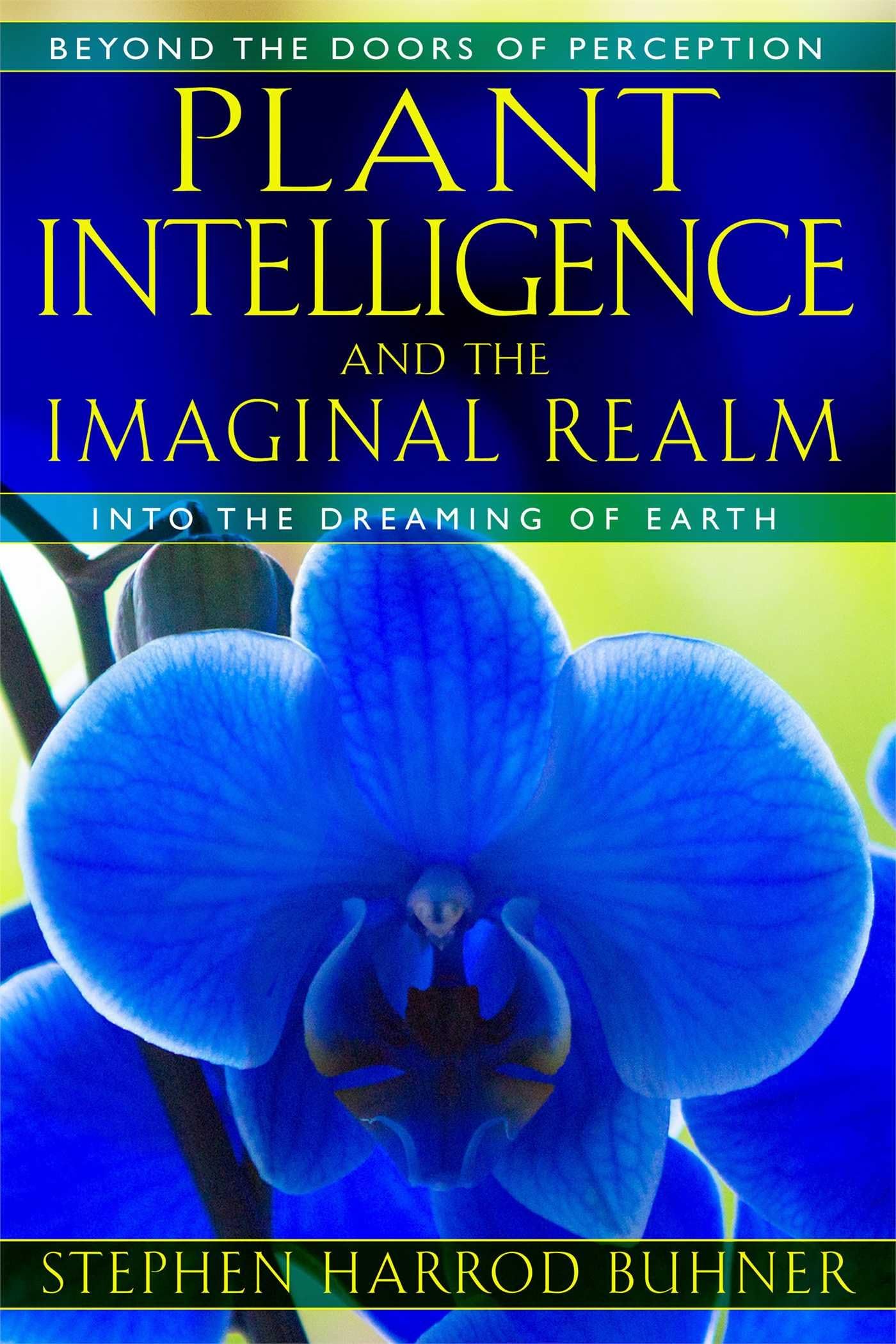
Plant Intelligence and the Imaginal Realm: Beyond the Doors of Perception into the Dreaming of Earth
Product ID: 1256128
🌿Gaia's living intelligence
📘Deep ecological insights
🧠Analogical & imaginal thinking
Desertcart purchases this item on your behalf and handles shipping, customs, and support to India.
🌍 Open the doors to Earth’s secret intelligence — don’t miss the awakening!
Plant Intelligence and the Imaginal Realm is a groundbreaking manual by Stephen Harrod Buhner that reveals the living intelligence of Earth’s ecosystems. Combining scientific rigor with poetic insight, it offers exercises to perceive and communicate with nature’s self-organizing systems, challenges human exceptionalism, and explores the ecological roles of plants, microbes, and humans. A must-read for those seeking to transform their understanding of the natural world and their place within it.
| Best Sellers Rank | #163,912 in Books ( See Top 100 in Books ) #53 in Gaia-based Religions #109 in Dreams (Books) #229 in Ecology (Books) |
| Customer Reviews | 4.7 out of 5 stars 527 Reviews |
A**Y
Mind-bending and important
So brilliantly insightful and mind-changing that despite some problems, I have to give Plant Intelligence the top rating. It's in my short list of books that have jolted my thinking off its comfortable rails into whole new paradigms. First of all, Plant Intelligence is only sort of about plants. It's also sort of about psychedelic drugs. It's not quite a polemic against human technological progress (though it heads in that direction), and also not quite a theory of living systems. It's poetic, recursive, loosely-structured and passionate, and as a reader I found it challenging and highly rewarding. Buhner lays out in great and scientific detail some little-known characteristics of plant ecosystems and the microbiome of the earth. This forms the basis for the rest of the book, which is a long reverie on the connectedness of all self-organizing systems, among which humanity is absolutely not "supreme" or even in any way special. Plant systems have "brains," and interact with their changing environment by exactly the same means as "intelligent" animal species; the earth itself is a living being responding intelligently to its environment (Buhner cites James Lovelock's Gaia hypothesis throughout the book); and the hubris that has driven humanity to its destructive practices will be no match for Gaia when Gaia shrugs its shoulders and brushes us off. Plant Intelligence was a slow read for me, because the scientific language demanded careful attention, and because I had to keep stopping to quote long, mind-blowing sections to friends and family. First there were vivid images of plant root systems all communicating via the same neurotransmitters our brains use. Then came the unsettling concept that humans aren't the free agents we think we are; we're really just working for the planet. (Bees, Buhner says by way of analogy, think they're collecting honey, and have no idea that they're pollinators). Next came awe as Buhner discussed how human creativity is only a response to the larger system eliciting something it needs from us. While this view says that free will is largely a fantasy, it also says that our creative works--our very lives--do have meaning and power whether or not other humans consciously know it. It abolishes in a single chapter the idea that only fame and fortune can validate our lives. Finally--and in what I felt was the weakest part of the book--Buhner lets loose his "barbarian" diatribe in favor of hallucinogenic drugs and against civilization. After spending some 400 pages building a beautifully spiraling idea structure, he seemed to lose sight of his own core idea, that humanity is just one (disposable) part of nature like all other parts. Instead, he regresses to the conventional notion that humanity and its technologies (particularly cities) are separate and uniquely bad, and that a libertarian, individualistic, back-to-the-land way of human life is somehow inherently "better" than urban life. Throughout the book, I was hoping he'd arrive at the logical conclusion, that cities are organic, natural structures arising in response to Gaia's promptings just as beehives and anthills and biofilms arose; and that the shamanic approach that he favors would apply equally to urban and "natural" environments. I had to sleep on his conclusions before realizing that my view (let's call it urban shamanism) is as likely to be valid as his, even though I haven't written a beautiful, challenging, poetic tome on the subject. Yet. On a final and more mundane note, Buhner's style poses some difficult editorial problems, and it's easy to imagine an editor just leaving most of it alone, but there are dozens of missing words, repeated phrases, and misspellings throughout the (Kindle edition) text that really should have been caught by a competent line-editor. This important book deserves better editing than it got.
K**R
This book is changing my life.
Many times in the course of reading Plant Intelligence and the Imaginal Realm I wanted to stop and post my reaction to the book here on Amazon. I resisted the temptation setting myself the goal of responding only when I was finished. And now I have done that. In this book Stephen Buhner proposed to me, in a most personal way, that I undertake my re-education. His single piece of advice was this: Whenever you encounter something ask yourself: How does it feel? So I will say how this book feels. This book feels heavy, not the heaviness of its actual weight, though it is not a short book, but the heaviness the old hippies referred to when they said, “That’s heavy, man.” Importance has its own kind of weight, and the weight of this book settles onto my body, not in any oppressive way but as if it were a fluid of warmth that conformed to every lineament of my physical self. But it was not my physical self that was embraced, it was rather my natural mind; it was, in the end, my heart. For this is a book of love if ever there was one and kindles love in response. It is as if someone nudged me awake from my sleep, gently but insistently. I knew at any moment I could say, “Leave me alone,” and the book would depart. Or I could let it rouse me. The book feels full of arousal, awake for the one who would awaken. So the book feels bright, not dazzling and brilliant in its brightness, not a brightness that causes squinting, but a brightness like the moon, never caustic, but when it is full adequate for many discoveries. The book is as stocked with joy as a spring river with trout. It abounds with an energy of the sort the old prophets felt when stirred by the touch of vision. It is lithe like a big cat moving in the forest; it is a repetitious as the old bardic chants composed of formulae worked and reworked in changing skeins. It has the generosity of the potlatch. It has the humor of clowns backstage taking off their facepaint. It calls as sweetly as the morning doves in my garden, seductive, soft, and hinting of intimacy. Feeling? Mine now on reading it: gratitude. The sense of dedication that breathes through this book touched me, held me as spell-bound as one is held by a great recitation. I love the man who wrote this book though I am not likely ever to meet him. Why? Because this book affirms something in me that needs affirming, seeks to feel affirmed. I feel I am in the presence of a true friend. Listen, I am 73 year old. I have a PhD in literature from Harvard. I taught in the academic world Buhner describes. AND I have had those experiences in my life which opened the doors of perception. But I have never quite found a guide to the heart of the earth. If I could only hand down to my children one book from all the books I have read, it would be this book. It is like a map---though not the territory---a golden thread through the labyrinth. Feel? it’s the feeling of having listened to a great song sung by a someone who has come back from a long journey with the wish to inspire me to travel there on my own.
J**N
Wowzers
I'm not even a quarter of the way through the book but wanted to write a review because I can't imagine this book losing stars as I continue to read... it's amazing! This book is so fascinating, in fact, I changed my syllabus a week ago to incorporate it into the curriculum. The students have browsed the book on Amazon and are already obsessing. We'll be reading it during our Shamanism + Plant Medicines unit in a "Poetry, World, and Spiritual Though" course. It fits in oh-so-perfectly. The writing style is multi-disciplinary, poetic, scientific, humorous, and curious. It's hard to read quickly, but you don't want to. It's the type of book that encourages meditative reverie and personal contemplation. Since my students come from all backgrounds (pre-med majors, liberal arts, architects, musicians, etc.) I think this book is a fantastic choice because there is truly something in it for everyone. The tone is welcoming and light but PACKED with hard-core information & observations about humans and our placement within an intelligent structure much grander than our mere selves. Like I said, I'm not even a quarter of the way through, so maybe the book will take a sharp turn and disappoint me, but I seriously doubt that.
C**E
Possibly the most important, mindblowing, astounding book I've ever read.
This may be the most important book you'll read this decade. Maybe ever. It re-enforces things that many of us have intuitively believed for a long time, but it does it through cutting edge science that is completely blowing my mind. Do you sort of think that the gaia hypothesis is kind of true--you know, maybe on a mythical or metaphorical level? Do you want proof that it is absolutely, scientifically true? The science presented here is mind blowing, paradigm shifting. As the mystics and native medicine people have been telling us forever, everything is connected, everything is conscious and communicates with everything else, the earth is actually a conscious, continually evolving being of which we and every other living thing are interconnected expressions. We have the capacity to actually SENSE this, feel it, know it in the ways that all people used to know it, back before the current scientific paradigm--now too slowly changing--started to convince us that we are all separate beings, and the rest of the universe, including the rest of "nature", is basically mechanical and unconscious and cannot communicate with us. The author gives exercises for developing this other way of sensing that we all are capable of but have mostly had beaten and "educated" and conditioned out of us. I'm actually not quite done reading the book yet, but each chapter fills me with more amazement, more "aha, yes, YES!" moments. I'm ordering at least 2 more copies to give to others. This is an absolute must read book, one that COULD help us to pull back from the precipice we are currently hanging over. We won't destroy the planet, though we are currently doing it very serious harm. But we may succeed in getting ourselves eradicated as a sadly failed experiment that was ultimately too destructive to the rest of the living planet of which we are but one expression. There's no way I can say words to do this book justice. Just read it, I totally promise you will not be disappointed. It may change your life. It will absolutely astound you, unless you yourself are a cutting edge biologist--and possibly even then. Just read it.
P**G
Brilliantly Insightful -- Life Changing
I know it's a big thing to say a book is "life-changing." It took me months to get through the first 15-20 pages, and when I finally did, I couldn't put it down. I found revelations on almost every page. Stephen Buhner's words changed my relationship to the rest of the living world - plant and animal - on a spiritual level, and shifted my understanding of life and of consciousness.
J**.
Reliving the Sixties.
This book is filled with a very wide array of fascinating ideas. Buhner has a poetic sense of the process of art and music-making. He is an excellent spokesman for the idea of Gaia. His book is very well paced, humorous, light-hearted about a heavy subject and fundamentally caring, considerate, intelligent, thoughtful. This book has a very ugly and fatal flaw - Buhner sings the praises of psychedelic ingestion throughout. He has obviously never had a loved one who lost their mind to LSD nor does he have any sensitivity or common sense in relation to many thousands of people who either lost their minds or any life purpose as the result of ingesting LSD. He's a bloviating ignoramus. Difficult to restrain ad hominem attacks but probably not necessary. In no particular order: 1. SB reiterates party-line New Age dogma re: narrow minded western science, western thought, rational, linear, deterministic thinking, western civilization in general-science, economics, politics etc. all very old 60s counterculture news - Buhner treats it as if it were a newsflash from his own mind. 2. SB rounds up all the usual late-60s subjects and sings of their deep ( a word he uses on average twice per page for 500 pages) wisdom: Bucky Fuller, Timothy Leary, Robert Bly, Albert Hoffmann and Jerry Garcia - probably because Garcia contains the letters of GAIA. That anb author in 2014 smacks of a time-warp. Much of this book could have been written 45 years ago. 3. This book reeks of bait and switch. There is very little here on plant intelligence and what little there is weak translations of the work of Lynn Margulis, Dorion Sagan, Richard Lovelock and Barbara McClintock. If you want plant intelligence read Margulis. If you want 45 year old hippie dogma read this book. It's like reading 500 pages of "Common Ground" One's smarm-alarm blares often. Like Jack Handey without the irony. 4. This book is a mushy jungle concoction of 18th century metaphysics gleaned from a casual reading of Goethe and poorly understood Darwinism. Buhner launches an interplanetary armada of Russell's teapots ( bold assertion made daring you to prove it wrong) 5. Hundreds of pages devoted to disparaging the work of millions of smart, sensitive, hardworking, scientists doing the real work of understanding our cosmos. This knowledge base is cherry picked by Buhner while he bad-raps the entire Enlightenment scientific enterprise. Positive aspects of "Plant Intelligence' 6. Buhner rant against the idea of professionalism and licensure is pathetic, dopey - does he want an unlicensed navigator or pilot on his flight to Tokyo? Pilot: " Hmmm, let's see - where does Tokyo feel like it wants to be today." or an unlicensed doctor? "Nurse - we're going to have to amputate." Positives: 1. Buhner's rant against corporatized, tainted science is welcome and timely. 2. He has a poetic understanding of art and music-making 3. Great selection of words of wisdom of others, aphorisms, etc., references to superb books and thinkers. 4. Gaian message - poetically expressed ( over and over and over and over) like a broken record. 5. Buhner tweaks the powerful - always useful. This book, like Stephen Jay Gould's masterpiece ( which Buhner ought to read) comes across more like an autobiography than a science book on plants. It has excellent parieto effect; though deeply flawed it inspires much thought.
S**L
RIP Stephen Buhner, a genius
I spent a week learning from Stephen Buhner after I had read all his books. I wasn't prepared for what his personal energy would bring. He made the hairs stand up on our arms! He created a cool wind on our necks. He made a vibe happen - everyone felt it deeply. He was as close to a warlock as I will ever know. Rest in peace, Stephen. You are a genius, an elder and wonderful being. You taught me the things about plants that come from inside of me, that I didn't know were already here. Thank you.
D**T
"Everything is Intelligent, " he writes in chapter four
Buhner has written a profound and important book designed to radically alter the way we "see" and relate to the natural world. He spices up his conversational writing style with numerous astonishing factoids from the natural world as well as sardonic wit and playful humor, all of which help make his forays into technical aspects of biology palatable for a general audience. "Everything is Intelligent," he writes in chapter four, illustrating his point with several amazing examples, including the co-evolutionary symbiosis between white pine trees and Clark's Nutcrackers--the latter equipped with a special throat pouch holding up to 100 seeds, and the ability to remember locations of up to 10,000 (!) buried caches of 2-5 seeds each for up to two years, its "super-human" memory feat matched by the ability to measure and triangulate those locations with "high-tech" precision. But the book's most important contribution to ecological sanity is its compelling support of the Gaia hypothesis--that Earth, and all the zillions of self-actualizing systems embedded within it, function to sustain a dynamic stability, which we humans ignore at our own peril, and at a great loss to our enjoyment of the biological and spiritual richness all around us. This is an absolutely brilliant book, and I couldn't recommend it more highly.
C**A
A book to open your perception
It does what it says it does. How rare to find a book of science with literary distinction. You begin wherever you are and as you read this book the new ways of seeing things slowly pile up. Come on in. The water’s fine.
S**T
and its being a layer in the biospheric wonder of our living planet and how we might ponder the workings of the intelligent awar
stephen assists me to remember my place as a cell of the organism humanity, and its being a layer in the biospheric wonder of our living planet and how we might ponder the workings of the intelligent aware living fractals of life, and these living fractals of intelligent awareness are myself, my species, my planet,and the universe. Crikie how did we as fellow members of our human family forget our being a part of nature. We aren't people standing on a planet we are inherently and inticately a part of it. Thankyou Stephen
A**R
Thank you!
This book is a blessing and I thank you for writing it. The information it contains is valuable beyond everyone's dearest imagination yet. Thank you for raising the collective awareness!
M**C
Cuestiones personales
No he conseguido leer más que unas pocas páginas. Yo esperaba un libro acerca de los vegetales y centrado en cuestiones de la vida vegetyy animal, pero parece un libro centrado en el autor y su vida, y aunque trata de los seres vivos lo hace con la actitud de asentar o defender una postura y de forma literaria con muchas citas de diversos autores de literatura... No lo he soportado.
L**H
Book
Fabulously, amazingly insightful.
Trustpilot
2 weeks ago
1 month ago