Capital and Ideology
Product ID: 150411638
Desertcart purchases this item on your behalf and handles shipping, customs, and support to India.
A New York Times Bestseller An NPR Best Book of the Year The epic successor to one of the most important books of the century: at once a retelling of global history, a scathing critique of contemporary politics, and a bold proposal for a new and fairer economic system. Thomas Piketty’s bestselling Capital in the Twenty-First Century galvanized global debate about inequality. In this audacious follow-up, Piketty challenges us to revolutionize how we think about politics, ideology, and history. He exposes the ideas that have sustained inequality for the past millennium, reveals why the shallow politics of right and left are failing us today, and outlines the structure of a fairer economic system. Our economy, Piketty observes, is not a natural fact. Markets, profits, and capital are all historical constructs that depend on choices. Piketty explores the material and ideological interactions of conflicting social groups that have given us slavery, serfdom, colonialism, communism, and hypercapitalism, shaping the lives of billions. He concludes that the great driver of human progress over the centuries has been the struggle for equality and education and not, as often argued, the assertion of property rights or the pursuit of stability. The new era of extreme inequality that has derailed that progress since the 1980s, he shows, is partly a reaction against communism, but it is also the fruit of ignorance, intellectual specialization, and our drift toward the dead-end politics of identity. Once we understand this, we can begin to envision a more balanced approach to economics and politics. Piketty argues for a new “participatory” socialism, a system founded on an ideology of equality, social property, education, and the sharing of knowledge and power. Capital and Ideology is destined to be one of the indispensable books of our time, a work that will not only help us understand the world, but that will change it. Review: Brilliant - Dr. Thomas Piketty’s (2019/2020)“Capital & Ideology,” 1093 pp., published through Harvard University Press is heroically thorough and extremely factually based with copious footnotes and with extensive on-line forums. (http://piketty.pse.ens.fr/fr/ideology and https://wid.world/. Piketty entertained us once before with “Capital in the 21st Century (2013).” The books main thrust was that a global capital gains tax and a few other tinkerings divulged in its 816 pages focused on mostly Western democracies, would severely help with global inequalities. His current opus is enormous in scope and provides descriptions of over 500 years’ worth of written history that includes Western democracies, and most notably, histories of Indian, Chinese, Japanese, and Brazilian economies. The purpose of his book is complex and at times redundant. His final chapter which focuses on what to “do” about our current situation is what he calls a “participatory socialism,” This tenant states that a circulation of funds vis-à-vis the USA and the world. To the say that is it far left pipe-dream economically would be the understatement of the century. Though the book seems a bit Francophile, (it was translated), he does an excellent job of describing many societies from their beginnings to their current iterations. To the point, his solution is to hand every person about $130,000 at the age of 25 or so, so they can either apply it to school loans, start a business, buy property, et cetera. To fund this ambitious plan of redistribute, taxes are going to go up A LOT on the people who CAN afford it. There would be steep, progressive taxation on income, inheritance, and property. Although, I think he deletes the concept propagated by Warren/Sanders of a wealth tax, this accordingly should be included here. He also envisions a carbon tax scheme that would also raise money. On its face, I think the tax increases would be a very good thing. In my personal opinion, inheritance taxes should be 100%, no one should inherit anything; if you did not earn it, and it is not yours for the taking. As for income, we have had top tax rates on or around 40% to 90% for decades until Mr. Reagan dropped the top rate from 70% to 28% in 1982. That is when inequality took off in the US. Additionally, property taxes are inherently cruel and regressive. Under his scheme, if I had an $800,000 house and owe, say, $600,000, I would owe an appraised tax on that $200,000 of equity (Instead of a tax on the 800k). If I were some millionaire or billionaire, my tax rate would be the same no matter what I owned at that time. That is why people like Warren Buffett, or the heir to the L’Oréal fortune pays a small rate of taxes even though both of those people are worth billions. If you are worth $50 billion, you should NOT be skating by and paying only 1% or so a year in property taxes, it should be much much higher. Seriously, how much money is enough? Dr. Piketty does go down the road of the “concept” of temporary ownership of property, but there is no real clear meaning on what that exactly means, so with that point I am skeptical. He additionally advocates for shared voting rights in firms, which is done very successfully in German and other Nordic countries with great effect. Workers have say on salaries and “how things are done,” on the cooperate boards instead of multiple voting rights by shareholders or voting by other out of touch individuals who speculate their next yacht purchase. Transparency is the most important tenant to be created. As such, this scheme would have to be enshrined in our Constitution since we cannot trust anything propagated by US lawmakers when it comes to power or money. An Amendment would have to state that incomes and monies would be fairly (not equally) distributed. Yes, this is a bit generalized, but something along these lines must be done to push forward with an agenda to make sure that everyone gets to enjoy the “great American success story,” that old maxim is always thrown around during election time. Obviously, universal health care, universal income, and schooling is placed in this equation. The concept of promoting transparency and doing away with the myth of meritocracy is also a given. University endowment funds need to be transparent and taxed at a very high rate. The concept of privilege needs to be exposed and dealt with from the university level all the way to the primary school level. The author goes even further in espousing open borders and the clear circulation of wealth between countries. Although I do agree with this concept at this time, it is something to consider in the future. As for chapters, Dr. Piketty expands a great deal on a variety of subjects. In the first five chapters he discusses the basic notion of inequality of cultures in the historical construct. After human’s hunting and gathering phase, we morphed into what he calls a “trifunctional society,” that still lasts to this day. The trifunctional class is the clergy, nobility, and the third estate. As we know in past history, the Catholic Church had enormous power, as did many other religions in their respective areas. Nobility could be landowners or anyone with a title sanction by the State or region. As for the third estate, these were just “people.” These workers are pretty much everyone else. This was about 90% of the population. They could have included workers, small time farmers, slaves, or serfs. Another main tenant of the book is the concept of private property and the rights that are guaranteed of it because of strong state power. If the state is not powerful enough, laws that protect private property are muted considerably. Thus, the invention of ownership societies, stratified societies into those who could live and function with ease versus those who could not. As we all know, it wasn’t until the early 20th century that most people without property could vote in any election in any area of the world. This was followed by the ending of suffrage for women (mostly) and for those that were slaves, serfs, or indigenous peoples in colonized area, probably universally around the 1960’s. In essence, the concept of the “why” was because of security of these institutions and also the “meaning,” behind them. The clergy and the nobility gave the reason for those to live (spirituality, ordained from God, etc.). Piketty posits that this is what led to ownership societies of land (especially Agrarian land) which provided for so much value and security. As we learn throughout history, it is the POWER OF THE STATE that guarantees such things and offers its protection of private property rights. If you need to garner anything from this book it is that concept right there. In great detail, Piketty expounds on the Ancien Regime and the Belle Époque, two times in history from the 1600’s to the late 1800’s when these society’s justified there inequality regimes with the premise of the “meaning and protection,” approach that I alluded to earlier. These type of regimes sprouted after the Roman Empire and used the conception framework of free work vis-à-vis slavery demarcated through colonialization (thank you, England and France) and serfdom. Piketty serves hundreds of pages and many chapters to these concepts alone. Trust me; you will know almost every faucet and financial angle of slavery and colonialism after reading these chapters. Piketty gave five chapters of this iteration not just from the Anglo-angle but also from Brazilian and Indian, (for India, which the British thoroughly exploited and made the caste system even worse due to a myriad of reasons). In essence, the concept of trifunctional turned into ternary societies that encompassed China and Japan as well. Basically there were stratification of society, albeit with different names but all basically did the same thing but perhaps with different percentages. The top two classes controlled 90% to 100% of everything and the rest of the population (which was the grand majority) didn’t own anything. Then something went horribly wrong. It was called World War I and World War II (1914-1945). Never in the history of time have States of the world become so close to equality or equalitarianism. That is because countries imploded and buildings and property were bombed or confiscated. Moreover, the concept of inheritance tax, income tax (especially the concept of progressive income tax) entered the foray and dramatically cut down the huge swaths of money and property that a small fraction of the world owned. In retrospect, Communism failed dramatically because it just switched the chairs on the Titanic. Private property was nonexistent, which gave all the power and control to the top elites; in this case, they were members of the higher echelon of the Communist party instead of nobility and the religious order. Again, nothing changed except for the names. What lead to Communists quick fall was that there was another option, democratic socialism that was propagated throughout the rest of Europe and the US. Debt forgiveness and the United States providing a progressive tax system, a balanced society financially, and high union rates, that ensured that society remain relatively egalitarian instead of what it was for the history of the world until now, basically skewed toward the very wealthy. To this end, this is where transparency is the most needed. In the explanation of countries in the Middle East, many are as inegalitarian as you can get with the very top percentages owning an extreme proportion of wealth. Equivalent to how Russia is after the disastrous fall of Communism. Alas, it could have leaned toward West European style socialism, but instead turned into the worst fringes of neoliberal capitalism. As eluded to earlier that Piketty focuses on France quite a bit, he explains the concept of a near 4-party system (that I will explain later) versus the US’s two-party system that has led the changing of party identification in Europe and especially in the US. What Piketty FAILS to bring into this argument is the extreme effect of slavery, racism, and systematic racism that has percolated through the US, after the civil war ending in 1865. No other country has felt it as extreme as the US. Slave owning President Thomas Jefferson wanted to send slaves BACK to Africa while slavery was a much-discussed mess in the early 1800’s. That is why the country of Liberia was formed. Again, Piketty, fails to factor into the equation all of the US’s atrocities of post-Civil War actions towards blacks after 1865 until the present. The US had guns and we didn’t compromise; clear and simple. As for England and France, they actually PAID the slaveholders as compensation to free the slaves. Yes, I know, provocative since the slave person himself didn’t get ANYTHING. This conversations above alone, can open up a can of worms and foment a large debate, but not warranted for this review. Interestingly, politically, many countries in Europe, and especially the US have changed its Republican and Democratic profile since the Civil War. The Democratic Party was the slave party, then jumped on the Irish and Italian bandwagon to procure votes to stay in power. The Republican Party that “did the right thing,” turned into the party of Goldwater (nee 1964) and Reagan, which in essence flipped roles. After Lyndon Johnson signed the Civil Rights Act of 1964, he allegedly said he “wrote off the South for a generation.” Yes, he was correct. Liberal Democrats put up with Southern Democrats to stay in power, but Goldwater, George Wallace, and the presidential attempt by Strom Thurmond in 1948, were are markings of conservative Southern Democrats turning into conservative Republicans. At that time, Piketty posits that the US turned into the Brahmin Left and Merchant Right that were pro-elite schools, mostly pro-immigration and shared the common desire of those two classes to control their respective countries. As a side note, in the past 40 years, the more educated you are the more Democratic you vote, as such, the more rich you are, the more Republican you vote. Many times, these complexities merge. In 2016, Mrs. Clinton received 75% of all voters who had doctorates in the US—which were about 2% at that time. The Democratic party abandoned the unionized households with their penchant for geopolitical free trade agreements and infatuation of Neoliberal economic structures postulated by the Chicago School (Milton Friedman), who wanted to turn most everything controlled by the State into cooperate or private hands (since they know best-not). This led to the proverbial screwing over of the middle and lower classes. This thinking really took off with Thatcher in 1979 and Reagan in 1981. The rest, as we should say, is history. Inequality and inegalitarianism is as high as it has ever been in the US. For me the most interesting aspect of the book can be found on page 791. Piketty explains the 4-way divide in French’s politics that is happening here in our two party system. There is the (1) Egalitarian internationalists (pro-immigrant, pro-labor)-thus the new Democratic party in the last 5 to 10 years. (2) The Inegalitarian nativists (anti-immigrant, pro-rich), the new Republican party in the last 5 to 10 years. (3) The Inegalitarian internationalists (pro-immigration, pro-rich) the party of Reagan, the Bushes, and Milton Friedman, the “old” Republican Party, and finally, (4) the Egalitarian nativists (anti-immigrant, pro-poor), I feel the “new-new” Republican Party. This party has many aspects of Trumpism that he is exploiting to a tee, along with the siphoning off of the other 3 branches. With the “browning” of American, I feel that number 4; will play a huge role in the Republican Party in the years to come. Piketty has a number of little nuggets that pop out. Something you would expect from a lengthy book. Such as China flailing for hundreds of years since they didn’t tax their citizens high enough and didn’t have a strong enough State. Ergo, they kept getting their butt beaten by the British again and again. In addition, during the conclusion, Piketty generally thinks that it is sad and not useful that we, as a society, always defer to economist when anything has to do with the economy. On its face, it may seem relevant, but this is why we have out of control capitalism. For that fact alone. Other disciplines are not taken into account! Again, this is just a short synopsis of the book itself. If you find a review that is shorter than this, they did not read the book cover to cover. I have seen some reviews by other distinguished authors and I will critique them lightly. As such, in one review, someone states that Dr. Piketty has an affinity for the Gini co-efficient. Although this is a broad scale measure of inequality, it has some factual inaccuracies and doesn’t measure the full inequality. In his book, on pages, 26, 657, and 659, he consistently states that he is not a fan of that measure. I will not deal with desertcart reviews since they are mostly political hacks with an agenda . Mr. Subramanian critique (Foreign Affairs-July/Aug 2020) is bland and predictable. I’m sorry. If someone has handed you an 1100 page opus and you think you can knit pick it down to a few pages, you’re a dullard. I’m sorry Mr. Subramanian, there is no “U-turn” between Dr. Piketty’s books. The latter is postulating that history had a choice at every turn to get it right, but their inherent greed and self-serving has always won the day. It may have taken 7 years for his books to enlighten this point. The critique bemoans that Piketty rattles on about the “sacralization of property,” Well of course he does, there was the root of the problem. Property conferred certain protection, moneymaking schemes, and voting rights, and those who had it wanted to limit it for others at every turn. It doesn’t take someone with a PhD to point this out—just watch any Netflix story. Trust me, it REALLY is that simple to realize human motivation. To continue, Mr. Subramanian continues to glorify billionaires (as if they discovered the holy grail) and feels that high tax rates are anathema to the world economy. Well, OF COURSE they are to the very rich. Between the two World Wars, the world never saw such equality. In addition, we had very very high tax rates. In fact, multiple studies show that economies of scale can withstand and thrive on high tax rates and margins on all profits and properties. Does he think the current situation is fair, equitable, and sustainable? I think not. Finally, and most atrociously, the author’s critique points to the “success” of China, India, and other prior fourth world economies that have severely cut their poverty rates amongst their populations. Oh yes, we have done the noble thing of making sure that the vast majority of people of the world make more than $1.90 a day, what an accomplishment! Inequalities are shrinking worldwide to a point, but it’s just like saying well, I’ve been stabbed and I’m bleeding, but I got the knife out and I’m bleeding a little less, only because I’m applying extreme pressure to the wound. Ergo, a Band-Aid approach. As for Fazi’s critique (American Affairs-Summer 2020), I would consider it spot on with appropriate language except for one possible issue I take issue with on page 166. Per him: “ Piketty is unable to resolve this constant tension between pragmatism and globalist idealism, which blinds him to the fact that transnational democracy, let alone transitional socialism is absolute unworkable…” That is Fazi’s strongest and most difficult argument to break. Fazi goes further stating that a transitional assembly would have to be formulated, along the line of the European Union (and we all know how that is working out), there would need to be some one-world government. Obviously, Mr. Fazi hasn’t watched science fiction, where in the Star Trek series that this is a real possibility, but I digress. Although I believe that Mr. Fazi is incorrect that a one-state world economy could not work. He states that since there is democracy or “demos,” it would be impossible to accept legitimacy and majority rule with so many different cultures. Ergo, a nation-state would have to be present (I presume he means multiple) and that collective decision-making would be impossible in a democracy. In a controlled environment with a King, I would presume so. Again, to proverbially throw your hands in the air , per Fazi, and state that nothing can be accomplished is nihilist and disingenuous at best. Of course, the world could do something if WE REALLY NEEDED TO. As a direct cut and paste from Wikipedia: In Paul Krugman’s review, he raises two questions: “whether Piketty knows enough about the areas he writes about to have constructed valid claims about the dozens of societies he discusses, and whether all of the case studies presented strengthen Piketty's core argument that rising inequality is fundamentally due to political choices.” I should hope that Dr. Krugman has a more thorough and respectable debunk somewhere in the literature, as such I have an enormous amount of respect for him, but this one paragraph actually made me spit out my morning coffee. Dr. Piketty DOES know enough about the areas to which he writes. It is backed up by copious notes and an on-line repository. Please, Dr. Krugman, let’s see you match that. As for rising inequality being fundamentally due to political choices, I think there is a strong argument that this IS the case. Does he have a competing theory? I’m anxiously holding my breath. Thank you, Dr. Piketty for educating and enlightening me on the world stage of inequality. This is clearly a 5 star review and clearly, the BEST economic book I have ever read. (Well, maybe besides Keynes and Polanyi). Review: A Defense of Regulatory Theory.... - Piketty has done it again! But in a very different way. The first book in this series, "Capital in the Twentieth Century" was fascinating as both an economics book but also its utilization of literature to dissect the nature of capital accumulation upon the lives of human beings. This book relies chiefly on long-term data analysis of the world's experiment with Capitalism. It is full of useful charts on income, wealthy, education, and voting patterns across the world and history. But it is much more than that. It is an empirical defense of Regulation Theory which makes it both an economic and historical work. Regulation Theory was a creation of both French economists and the Annales School of French historians. These individuals abandoned predictive pretensions and grand theory for historical analysis of people, government, laws, and markets. Conclusions are based on statistical analysis of historical records instead of economic modeling. Piketty has chosen to not utilize tradition common or academic names for concepts throughout the work in order to avoid knee-jerk reactions from readers in advance of his arguments and evidence. So let me explain certain aspects that will connect existing theory with the book's desire to avoid Postmodern literary wording hang ups. Regulation Theory revolves around two central concepts: Modes of Regulation (MOR) and Regimes of Capital Accumulation (ROA). MOR is the basic system of rules and regulations that have been implemented by a society and on its exchange mechanisms. ROA is the impact of the MOR on the way wealthy is earned and retained in the society. Piketty analyzes this for the Ancien Regime, the First Industrial Revolution, the Second Industrial Revolution and Colonialism, the Fordist Era, and the first part of the 21st century. In this work, he also expands these analyses beyond the Western world where the historical record allows him to especially in India, China, Russia, and Brazil. In the introduction the author explains why the MOR and the ROA are integral to the title, "Capital and Ideology": "Every human society must justify its inequalities: unless reasons for them are found, the whole political and social edifice stands in danger of collapse. Every epoch therefore develops a range of contradictory discourses and ideologies for the purpose of legitimizing the inequality that already exists or that people believe should exist. From these discourses emerge certain economic, social, and political rules, which people then use to make sense of the ambient social structure. Out of the clash of contradictory discourses - a clash that is at once economic, social, and political - comes a dominant narrative or narratives, which bolster the existing inequality regime." As you can see Rules equals MOR and Inequality equals ROA, Ideology equals Politics. Who wins the ideological (elections) fight defines the regulatory standards of the society and its markets. Piketty covers several different types of societies and how their rules and regulations have been the basis and justification of their systems but avoids their traditional naming styles. The Ancien Regime is, for instance, called Ternary Societies reflecting their division between the nobility, the priesthood, and the commoners. The Classical Liberal period is the Proprietarian or Ownership Society including its relationship to slavery and colonialism. The bulk of the Fordist Era is divided between Social Democratic systems and Communist states. Our current Neoliberal period is known as the Neo-Proprietarian Society. This connection between power and ideology is why the book covers not just economics but politics, elections, and voting franchise. The author is not only interested in defending theories of Structural Marxism dating from the 70s, but rather, to provide solutions for an improved society in the future. He explores co-management law, progressive income and wealthy taxes, universal basic income, capital endowments, free education initiatives, and the need for a transnational regulatory regime. After avoiding loaded terminology he dives in with both feet and calls these reforms, this ideology: Participatory Socialism. Whether you agree with his conclusions or not, reading this book is both fascinating and it will provide you with a vast body of facts and access to an even vaster online database. It is a big read but a worthwhile one.




| Best Sellers Rank | #83,250 in Books ( See Top 100 in Books ) #10 in Comparative Economics (Books) #37 in Income Inequality #43 in Development & Growth Economics (Books) |
| Customer Reviews | 4.7 out of 5 stars 976 Reviews |
M**.
Brilliant
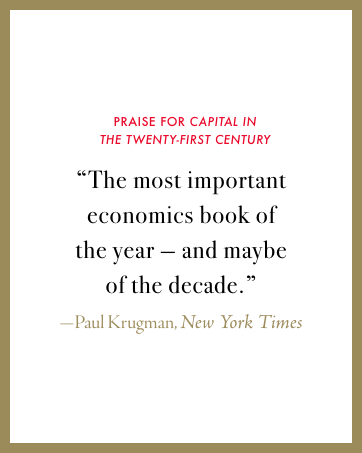
Dr. Thomas Piketty’s (2019/2020)“Capital & Ideology,” 1093 pp., published through Harvard University Press is heroically thorough and extremely factually based with copious footnotes and with extensive on-line forums. (http://piketty.pse.ens.fr/fr/ideology and https://wid.world/. Piketty entertained us once before with “Capital in the 21st Century (2013).” The books main thrust was that a global capital gains tax and a few other tinkerings divulged in its 816 pages focused on mostly Western democracies, would severely help with global inequalities. His current opus is enormous in scope and provides descriptions of over 500 years’ worth of written history that includes Western democracies, and most notably, histories of Indian, Chinese, Japanese, and Brazilian economies. The purpose of his book is complex and at times redundant. His final chapter which focuses on what to “do” about our current situation is what he calls a “participatory socialism,” This tenant states that a circulation of funds vis-à-vis the USA and the world. To the say that is it far left pipe-dream economically would be the understatement of the century. Though the book seems a bit Francophile, (it was translated), he does an excellent job of describing many societies from their beginnings to their current iterations. To the point, his solution is to hand every person about $130,000 at the age of 25 or so, so they can either apply it to school loans, start a business, buy property, et cetera. To fund this ambitious plan of redistribute, taxes are going to go up A LOT on the people who CAN afford it. There would be steep, progressive taxation on income, inheritance, and property. Although, I think he deletes the concept propagated by Warren/Sanders of a wealth tax, this accordingly should be included here. He also envisions a carbon tax scheme that would also raise money. On its face, I think the tax increases would be a very good thing. In my personal opinion, inheritance taxes should be 100%, no one should inherit anything; if you did not earn it, and it is not yours for the taking. As for income, we have had top tax rates on or around 40% to 90% for decades until Mr. Reagan dropped the top rate from 70% to 28% in 1982. That is when inequality took off in the US. Additionally, property taxes are inherently cruel and regressive. Under his scheme, if I had an $800,000 house and owe, say, $600,000, I would owe an appraised tax on that $200,000 of equity (Instead of a tax on the 800k). If I were some millionaire or billionaire, my tax rate would be the same no matter what I owned at that time. That is why people like Warren Buffett, or the heir to the L’Oréal fortune pays a small rate of taxes even though both of those people are worth billions. If you are worth $50 billion, you should NOT be skating by and paying only 1% or so a year in property taxes, it should be much much higher. Seriously, how much money is enough? Dr. Piketty does go down the road of the “concept” of temporary ownership of property, but there is no real clear meaning on what that exactly means, so with that point I am skeptical. He additionally advocates for shared voting rights in firms, which is done very successfully in German and other Nordic countries with great effect. Workers have say on salaries and “how things are done,” on the cooperate boards instead of multiple voting rights by shareholders or voting by other out of touch individuals who speculate their next yacht purchase. Transparency is the most important tenant to be created. As such, this scheme would have to be enshrined in our Constitution since we cannot trust anything propagated by US lawmakers when it comes to power or money. An Amendment would have to state that incomes and monies would be fairly (not equally) distributed. Yes, this is a bit generalized, but something along these lines must be done to push forward with an agenda to make sure that everyone gets to enjoy the “great American success story,” that old maxim is always thrown around during election time. Obviously, universal health care, universal income, and schooling is placed in this equation. The concept of promoting transparency and doing away with the myth of meritocracy is also a given. University endowment funds need to be transparent and taxed at a very high rate. The concept of privilege needs to be exposed and dealt with from the university level all the way to the primary school level. The author goes even further in espousing open borders and the clear circulation of wealth between countries. Although I do agree with this concept at this time, it is something to consider in the future. As for chapters, Dr. Piketty expands a great deal on a variety of subjects. In the first five chapters he discusses the basic notion of inequality of cultures in the historical construct. After human’s hunting and gathering phase, we morphed into what he calls a “trifunctional society,” that still lasts to this day. The trifunctional class is the clergy, nobility, and the third estate. As we know in past history, the Catholic Church had enormous power, as did many other religions in their respective areas. Nobility could be landowners or anyone with a title sanction by the State or region. As for the third estate, these were just “people.” These workers are pretty much everyone else. This was about 90% of the population. They could have included workers, small time farmers, slaves, or serfs. Another main tenant of the book is the concept of private property and the rights that are guaranteed of it because of strong state power. If the state is not powerful enough, laws that protect private property are muted considerably. Thus, the invention of ownership societies, stratified societies into those who could live and function with ease versus those who could not. As we all know, it wasn’t until the early 20th century that most people without property could vote in any election in any area of the world. This was followed by the ending of suffrage for women (mostly) and for those that were slaves, serfs, or indigenous peoples in colonized area, probably universally around the 1960’s. In essence, the concept of the “why” was because of security of these institutions and also the “meaning,” behind them. The clergy and the nobility gave the reason for those to live (spirituality, ordained from God, etc.). Piketty posits that this is what led to ownership societies of land (especially Agrarian land) which provided for so much value and security. As we learn throughout history, it is the POWER OF THE STATE that guarantees such things and offers its protection of private property rights. If you need to garner anything from this book it is that concept right there. In great detail, Piketty expounds on the Ancien Regime and the Belle Époque, two times in history from the 1600’s to the late 1800’s when these society’s justified there inequality regimes with the premise of the “meaning and protection,” approach that I alluded to earlier. These type of regimes sprouted after the Roman Empire and used the conception framework of free work vis-à-vis slavery demarcated through colonialization (thank you, England and France) and serfdom. Piketty serves hundreds of pages and many chapters to these concepts alone. Trust me; you will know almost every faucet and financial angle of slavery and colonialism after reading these chapters. Piketty gave five chapters of this iteration not just from the Anglo-angle but also from Brazilian and Indian, (for India, which the British thoroughly exploited and made the caste system even worse due to a myriad of reasons). In essence, the concept of trifunctional turned into ternary societies that encompassed China and Japan as well. Basically there were stratification of society, albeit with different names but all basically did the same thing but perhaps with different percentages. The top two classes controlled 90% to 100% of everything and the rest of the population (which was the grand majority) didn’t own anything. Then something went horribly wrong. It was called World War I and World War II (1914-1945). Never in the history of time have States of the world become so close to equality or equalitarianism. That is because countries imploded and buildings and property were bombed or confiscated. Moreover, the concept of inheritance tax, income tax (especially the concept of progressive income tax) entered the foray and dramatically cut down the huge swaths of money and property that a small fraction of the world owned. In retrospect, Communism failed dramatically because it just switched the chairs on the Titanic. Private property was nonexistent, which gave all the power and control to the top elites; in this case, they were members of the higher echelon of the Communist party instead of nobility and the religious order. Again, nothing changed except for the names. What lead to Communists quick fall was that there was another option, democratic socialism that was propagated throughout the rest of Europe and the US. Debt forgiveness and the United States providing a progressive tax system, a balanced society financially, and high union rates, that ensured that society remain relatively egalitarian instead of what it was for the history of the world until now, basically skewed toward the very wealthy. To this end, this is where transparency is the most needed. In the explanation of countries in the Middle East, many are as inegalitarian as you can get with the very top percentages owning an extreme proportion of wealth. Equivalent to how Russia is after the disastrous fall of Communism. Alas, it could have leaned toward West European style socialism, but instead turned into the worst fringes of neoliberal capitalism. As eluded to earlier that Piketty focuses on France quite a bit, he explains the concept of a near 4-party system (that I will explain later) versus the US’s two-party system that has led the changing of party identification in Europe and especially in the US. What Piketty FAILS to bring into this argument is the extreme effect of slavery, racism, and systematic racism that has percolated through the US, after the civil war ending in 1865. No other country has felt it as extreme as the US. Slave owning President Thomas Jefferson wanted to send slaves BACK to Africa while slavery was a much-discussed mess in the early 1800’s. That is why the country of Liberia was formed. Again, Piketty, fails to factor into the equation all of the US’s atrocities of post-Civil War actions towards blacks after 1865 until the present. The US had guns and we didn’t compromise; clear and simple. As for England and France, they actually PAID the slaveholders as compensation to free the slaves. Yes, I know, provocative since the slave person himself didn’t get ANYTHING. This conversations above alone, can open up a can of worms and foment a large debate, but not warranted for this review. Interestingly, politically, many countries in Europe, and especially the US have changed its Republican and Democratic profile since the Civil War. The Democratic Party was the slave party, then jumped on the Irish and Italian bandwagon to procure votes to stay in power. The Republican Party that “did the right thing,” turned into the party of Goldwater (nee 1964) and Reagan, which in essence flipped roles. After Lyndon Johnson signed the Civil Rights Act of 1964, he allegedly said he “wrote off the South for a generation.” Yes, he was correct. Liberal Democrats put up with Southern Democrats to stay in power, but Goldwater, George Wallace, and the presidential attempt by Strom Thurmond in 1948, were are markings of conservative Southern Democrats turning into conservative Republicans. At that time, Piketty posits that the US turned into the Brahmin Left and Merchant Right that were pro-elite schools, mostly pro-immigration and shared the common desire of those two classes to control their respective countries. As a side note, in the past 40 years, the more educated you are the more Democratic you vote, as such, the more rich you are, the more Republican you vote. Many times, these complexities merge. In 2016, Mrs. Clinton received 75% of all voters who had doctorates in the US—which were about 2% at that time. The Democratic party abandoned the unionized households with their penchant for geopolitical free trade agreements and infatuation of Neoliberal economic structures postulated by the Chicago School (Milton Friedman), who wanted to turn most everything controlled by the State into cooperate or private hands (since they know best-not). This led to the proverbial screwing over of the middle and lower classes. This thinking really took off with Thatcher in 1979 and Reagan in 1981. The rest, as we should say, is history. Inequality and inegalitarianism is as high as it has ever been in the US. For me the most interesting aspect of the book can be found on page 791. Piketty explains the 4-way divide in French’s politics that is happening here in our two party system. There is the (1) Egalitarian internationalists (pro-immigrant, pro-labor)-thus the new Democratic party in the last 5 to 10 years. (2) The Inegalitarian nativists (anti-immigrant, pro-rich), the new Republican party in the last 5 to 10 years. (3) The Inegalitarian internationalists (pro-immigration, pro-rich) the party of Reagan, the Bushes, and Milton Friedman, the “old” Republican Party, and finally, (4) the Egalitarian nativists (anti-immigrant, pro-poor), I feel the “new-new” Republican Party. This party has many aspects of Trumpism that he is exploiting to a tee, along with the siphoning off of the other 3 branches. With the “browning” of American, I feel that number 4; will play a huge role in the Republican Party in the years to come. Piketty has a number of little nuggets that pop out. Something you would expect from a lengthy book. Such as China flailing for hundreds of years since they didn’t tax their citizens high enough and didn’t have a strong enough State. Ergo, they kept getting their butt beaten by the British again and again. In addition, during the conclusion, Piketty generally thinks that it is sad and not useful that we, as a society, always defer to economist when anything has to do with the economy. On its face, it may seem relevant, but this is why we have out of control capitalism. For that fact alone. Other disciplines are not taken into account! Again, this is just a short synopsis of the book itself. If you find a review that is shorter than this, they did not read the book cover to cover. I have seen some reviews by other distinguished authors and I will critique them lightly. As such, in one review, someone states that Dr. Piketty has an affinity for the Gini co-efficient. Although this is a broad scale measure of inequality, it has some factual inaccuracies and doesn’t measure the full inequality. In his book, on pages, 26, 657, and 659, he consistently states that he is not a fan of that measure. I will not deal with Amazon reviews since they are mostly political hacks with an agenda . Mr. Subramanian critique (Foreign Affairs-July/Aug 2020) is bland and predictable. I’m sorry. If someone has handed you an 1100 page opus and you think you can knit pick it down to a few pages, you’re a dullard. I’m sorry Mr. Subramanian, there is no “U-turn” between Dr. Piketty’s books. The latter is postulating that history had a choice at every turn to get it right, but their inherent greed and self-serving has always won the day. It may have taken 7 years for his books to enlighten this point. The critique bemoans that Piketty rattles on about the “sacralization of property,” Well of course he does, there was the root of the problem. Property conferred certain protection, moneymaking schemes, and voting rights, and those who had it wanted to limit it for others at every turn. It doesn’t take someone with a PhD to point this out—just watch any Netflix story. Trust me, it REALLY is that simple to realize human motivation. To continue, Mr. Subramanian continues to glorify billionaires (as if they discovered the holy grail) and feels that high tax rates are anathema to the world economy. Well, OF COURSE they are to the very rich. Between the two World Wars, the world never saw such equality. In addition, we had very very high tax rates. In fact, multiple studies show that economies of scale can withstand and thrive on high tax rates and margins on all profits and properties. Does he think the current situation is fair, equitable, and sustainable? I think not. Finally, and most atrociously, the author’s critique points to the “success” of China, India, and other prior fourth world economies that have severely cut their poverty rates amongst their populations. Oh yes, we have done the noble thing of making sure that the vast majority of people of the world make more than $1.90 a day, what an accomplishment! Inequalities are shrinking worldwide to a point, but it’s just like saying well, I’ve been stabbed and I’m bleeding, but I got the knife out and I’m bleeding a little less, only because I’m applying extreme pressure to the wound. Ergo, a Band-Aid approach. As for Fazi’s critique (American Affairs-Summer 2020), I would consider it spot on with appropriate language except for one possible issue I take issue with on page 166. Per him: “ Piketty is unable to resolve this constant tension between pragmatism and globalist idealism, which blinds him to the fact that transnational democracy, let alone transitional socialism is absolute unworkable…” That is Fazi’s strongest and most difficult argument to break. Fazi goes further stating that a transitional assembly would have to be formulated, along the line of the European Union (and we all know how that is working out), there would need to be some one-world government. Obviously, Mr. Fazi hasn’t watched science fiction, where in the Star Trek series that this is a real possibility, but I digress. Although I believe that Mr. Fazi is incorrect that a one-state world economy could not work. He states that since there is democracy or “demos,” it would be impossible to accept legitimacy and majority rule with so many different cultures. Ergo, a nation-state would have to be present (I presume he means multiple) and that collective decision-making would be impossible in a democracy. In a controlled environment with a King, I would presume so. Again, to proverbially throw your hands in the air , per Fazi, and state that nothing can be accomplished is nihilist and disingenuous at best. Of course, the world could do something if WE REALLY NEEDED TO. As a direct cut and paste from Wikipedia: In Paul Krugman’s review, he raises two questions: “whether Piketty knows enough about the areas he writes about to have constructed valid claims about the dozens of societies he discusses, and whether all of the case studies presented strengthen Piketty's core argument that rising inequality is fundamentally due to political choices.” I should hope that Dr. Krugman has a more thorough and respectable debunk somewhere in the literature, as such I have an enormous amount of respect for him, but this one paragraph actually made me spit out my morning coffee. Dr. Piketty DOES know enough about the areas to which he writes. It is backed up by copious notes and an on-line repository. Please, Dr. Krugman, let’s see you match that. As for rising inequality being fundamentally due to political choices, I think there is a strong argument that this IS the case. Does he have a competing theory? I’m anxiously holding my breath. Thank you, Dr. Piketty for educating and enlightening me on the world stage of inequality. This is clearly a 5 star review and clearly, the BEST economic book I have ever read. (Well, maybe besides Keynes and Polanyi).
G**O
A Defense of Regulatory Theory....
Piketty has done it again! But in a very different way. The first book in this series, "Capital in the Twentieth Century" was fascinating as both an economics book but also its utilization of literature to dissect the nature of capital accumulation upon the lives of human beings. This book relies chiefly on long-term data analysis of the world's experiment with Capitalism. It is full of useful charts on income, wealthy, education, and voting patterns across the world and history. But it is much more than that. It is an empirical defense of Regulation Theory which makes it both an economic and historical work. Regulation Theory was a creation of both French economists and the Annales School of French historians. These individuals abandoned predictive pretensions and grand theory for historical analysis of people, government, laws, and markets. Conclusions are based on statistical analysis of historical records instead of economic modeling. Piketty has chosen to not utilize tradition common or academic names for concepts throughout the work in order to avoid knee-jerk reactions from readers in advance of his arguments and evidence. So let me explain certain aspects that will connect existing theory with the book's desire to avoid Postmodern literary wording hang ups. Regulation Theory revolves around two central concepts: Modes of Regulation (MOR) and Regimes of Capital Accumulation (ROA). MOR is the basic system of rules and regulations that have been implemented by a society and on its exchange mechanisms. ROA is the impact of the MOR on the way wealthy is earned and retained in the society. Piketty analyzes this for the Ancien Regime, the First Industrial Revolution, the Second Industrial Revolution and Colonialism, the Fordist Era, and the first part of the 21st century. In this work, he also expands these analyses beyond the Western world where the historical record allows him to especially in India, China, Russia, and Brazil. In the introduction the author explains why the MOR and the ROA are integral to the title, "Capital and Ideology": "Every human society must justify its inequalities: unless reasons for them are found, the whole political and social edifice stands in danger of collapse. Every epoch therefore develops a range of contradictory discourses and ideologies for the purpose of legitimizing the inequality that already exists or that people believe should exist. From these discourses emerge certain economic, social, and political rules, which people then use to make sense of the ambient social structure. Out of the clash of contradictory discourses - a clash that is at once economic, social, and political - comes a dominant narrative or narratives, which bolster the existing inequality regime." As you can see Rules equals MOR and Inequality equals ROA, Ideology equals Politics. Who wins the ideological (elections) fight defines the regulatory standards of the society and its markets. Piketty covers several different types of societies and how their rules and regulations have been the basis and justification of their systems but avoids their traditional naming styles. The Ancien Regime is, for instance, called Ternary Societies reflecting their division between the nobility, the priesthood, and the commoners. The Classical Liberal period is the Proprietarian or Ownership Society including its relationship to slavery and colonialism. The bulk of the Fordist Era is divided between Social Democratic systems and Communist states. Our current Neoliberal period is known as the Neo-Proprietarian Society. This connection between power and ideology is why the book covers not just economics but politics, elections, and voting franchise. The author is not only interested in defending theories of Structural Marxism dating from the 70s, but rather, to provide solutions for an improved society in the future. He explores co-management law, progressive income and wealthy taxes, universal basic income, capital endowments, free education initiatives, and the need for a transnational regulatory regime. After avoiding loaded terminology he dives in with both feet and calls these reforms, this ideology: Participatory Socialism. Whether you agree with his conclusions or not, reading this book is both fascinating and it will provide you with a vast body of facts and access to an even vaster online database. It is a big read but a worthwhile one.
E**S
Help End The Identitarian and Nativist Forces
I spent the better part of the last month reading this 1,000 page monster, and once I apprehended the preliminaries I moved along at a good clip, finding fascinating answers to numerous questions I've had--with ample room to "dialogue" with the writing in a way I've found expansive and rewarding. One thing is certain, Piketty's ideas are a stunning and forceful turn away from some of the libertarianism-informed weirdness one finds in what is sometimes labeled Neoclassical economics, and other times as the Austrian School. That's in part the best offering the book presents. It's long been troubling to me how we currently see a stand-off between "the globalists" and "the nationalists" in America's poorly-informed mass media-dominated landscape. "Capital and Ideology" explains the suspicions of the so-called "nationalist school", and then demonstrates how such problems are actually fed by hyper-capitalism, or neoliberalism, or a commercial and financial regime where bad actors supposedly self-regulate in a "market" that self-regulates, and blah, blah, blah. This author's observations are also especially refreshing in how he advocates the abandonment of the horribly inaccurate left-right dichotomy while connoting that the actual problem is between representative republican democracies and hyper-capitalism. This is a post-Cold War world where some of the more reactionary bloviators are still in throw-back territory. He posits some solutions along the lines of those who seek to repair the damaged "nation-state" by reinforcing a regulatory grid that is transnational in character--but I worry that's going to take a worldwide economic disaster so thorough that the powerful who presently oppose such a solution will be forced to crawl to the table. Like the last time, the Great Depression, when bad actors within the economy almost blew-up civilization. The gruff among us will complain about "socialism" as if that's "all bad all the time". What those spirits are afraid of is, of course, losing some of their toys. And prestige. And economic power. And influence. The stacked deck behind which billions of dollars have been placed to keep it that way.
R**E
Good data, analytically wanting
The author does provide a great historical analysis of inequality, which could be done a bit more succinctly. The argument that the current inequalities are unjust is not convincingly proven. It is unfortunate that he did not address, but tangentially, the link between outcomes and efforts in the resulting inequalities. The fact that growth has been stronger when societies were more equal is very strong and valid. Giving some parameters around what would be an ideal equality would be helpful.
D**E
Billons and insufferable product placement
I am not an economist, banker, market analyst, or social commentator. The main reason I purchased Thomas Piketty's classic Capital and Ideology is because when watching Billons (on Showtime) I was always looking for product placements. Billions had so many "Easter egg" placements, (particularly what people drank and wore); it was fun to find and pick them out. Anyway Paul Giamatti, as insufferable character Chuck Rhoades; insufferable in the spirit of self righteousness; had a copy and he was shown appearing to intently "thumb through a copy". "Hey, I should add that to my library" was my immediate thought. "It would look great on my book shelf with Adam Smith's Wealth of Nations."! (My own insufferable ability?). As I looked online at Amazon, I was happy to find a used copy available to be shipped from a Goodwill not 20 miles from my house. Books like this - new - can be quite expensive. Used? The copy I received appeared to have never been read or even cracked open. Another fellow "this book should be on my shelf" person? Probably. I think Billons was making more of a reinforcing comment about Chuck Rhoades haughty intellectualism and social stances, than a recommendation to read Capital and Ideology, as most reviews you might read would indicate that C&I is a long detailed book with plenty to digest -- suggesting more of a tome, than something you might casually pick up and thumb through. Yes, Capital and Ideology is a textbook tome, in the best way, summarized with some Cliff Notes help: "a comprehensive analysis of inequality, tracing its roots in historical and ideological constructs, not just economic ones. Piketty argues that inequality is not an inevitable outcome of capitalism but rather a product of human choices and the dominant ideologies shaping those choices." That said, I have found myself thumbing through it, but not too intently. Just enough to say, I have looked.
M**S
A Very Long Breath Of Fresh Air
“No one is going to read a 1,000-page book, especially on something as boring as economics.” Perhaps. But they should. Because Piketty’s Capital and Ideology is the best articulation to date of global inequality and the reasons we give (or accept) for its justification. His detailed descriptions of various forms of inequality have a single aim: “to enable citizens to reclaim possession of economic and historical knowledge” (which he, rightly, sees as necessary for democratic deliberation). In a nutshell, Piketty is claiming that while democracy must remain open-ended and subject to revision, its complexity should not be mistaken for unfeasibility. Like the pragmatist John Dewey before him, he considers democratic deliberation to be “both an end and a means,” the way we achieve a more equitable society as well as the goal we hope to achieve. But he also realizes that real world inequities will not allow “democracy” to remain a vague or ephemeral concept. “Hence,” he says, “it is wise to be wary of abstract and general principles of social justice and to concentrate instead on the way in which those principles are embodied in specific societies and concrete policies and institutions.” For that reason, he implores us to consider wages and profits in terms of social justice, taxes as means of addressing inequalities, debts as measures of human relations, and economics generally as how we manage our global involvement. Much like the ancient Greek notion of οἰκονόμος - as a sort of “(existential) housekeeping” - Piketty’s use of “economics” roughly translates as “how we might best conduct ourselves” (as much a matter of ethics and politics as anything typically economical). And following Marx’ admonition to not only talk about the world but to change it, Piketty has provided us with many of the tools we need to do just that – i.e. create a more just world, one in which nationalism and xenophobia slowly and peacefully give way to a more just and equitable global democracy, where environmental issues are no longer considered “externalities” but intricacies of the only “house” we have to manage. In short, if it’s a better future you’re hoping for, Piketty’s Capital and Ideology will give you not only good reason to believe in the possibility, but much of what will be necessary if we are to achieve it.
M**T
This is a pretty good ideology.
When one sets out to show that every society must justify its inequality where does one go? Piketty goes around the world. He starts as far back as the data allows (early 1700s) and finishes with the present. It really is a whirlwind. Here are some topics that I particularly liked. * The categories of wealth tax * The debate regarding the compensation of slaveholders, a great example of how fanatical nations became about property rights. * Russia's sudden transformation from communism to hypercapitalism * The concept of Brahmin Left and Merchant Right and its similarities with ternary societies * America's dominance as a result of primary and secondary education * The liberalization of capital * An overview of race to the bottom * British enforcement/creation of castes in India * Pop culture references like the song "Trust fund baby", Muse, and Netflix's Occupied. * Sweden's secret and unequal past * Multiple fun thought experiments like the government trying to buy all the private assets by printing money * National income as a concept * How debts were paid off after WWII * Co-Management and its variations * Opacity of financial information despite the existence of IT I certainly did not foresee coming across many of these ideas. In an effort to be thorough, one can end up in far off places. By the end, I felt inspired. We need to experiment. We need to reevaluate some of our basic beliefs on what societies can do, or, more broadly, what justice is. The arguments for inequality look increasingly specious. Concepts that reign in the US like... * Inequality fuels growth * Socialism is Pandora's box * The US is a meritocracy * The wealthy will just leave * The fiscal system is too complex and can never be monitored * Governments always spend money poorly I think were addressed very well. Thank you Piketty for a nice COVID read.
J**S
Don't let the length of the book scare you.
I'm halfway through. There are tons of footnotes that make the book look bigger. It's a comfortable read. It flows. a good translation. This is a monumental, historical book just like Capital in the 21st Century. Picketty measures inequality over time. Inequality is slowly evolving away. Slowly when you take the long view of human history. But the last 200 years have shown great advances with brutal setbacks. Just what you would expect. Can mankind transcend the slow process of evolution by brute political conflict and simply realize where social evolution is going, and just go there. We know that we will eventually restrict inequality by law to a reasonable level. Why not just go there now? Why wait for social evolution? Why suffer through the anxiety and inefficiency of battles by brute political force.
T**G
The second, and as equally good, book from Thomas Piketty.
I like how much detail the author has relied upon, over many centuries in western nations and regions, has accumulated, aggregated, and presented in an ideological way that makes his arguments compellling and so well argued.
J**A
Mandatory reading
All policymakers around the world should read and adopt strategies to reduce inequality, based on historic facts, conclusions and recommendations from this book. Inequality will destroy capitalism and democracy.
T**R
Huge scope supports clear proposals to fix current international political and economic problems.
A fascinating read, should be required reading for all politicians. In depth yet accessible to the general reader, with many illustrative graphs and clear interpretations of each one. You do not need to be an economist to read this. The section on constructive reform of EU institutions was a particular highlight for me.
C**E
私有財産の神聖視はやめよう!
現状の不平等を正当化するロジックは歴史的に常に存在してきた。でも不平等は経済的でも科学技術の進歩によるものでもなく、イデオロギーそして政治的な帰結なのだ。社会がどう構築されるべきかを決めるのは境界と所有権の2点だ。参政権があるのは誰か、領土はどこまでか、他国とどう接するか。そして何を持てるか、どう世代に受け継がれるかなど。歴史的に色々な方法が試されており、今ある不平等は不可避のものではない。1980年代以降税の累進制は減り資本の不透明な循環が加速したが、これを防ぐことができなかったのはなぜかという疑問が起こる。1950~70年代は英労働党も米民主党も貧しく教育の無い者が支持していたが、1980年代からは教育のある者が支持するようになり、1990~2010年では金持ちが支持するようになった。貧者は左翼を見捨てた。社会民主的連合は貧者を統合するようなイデオロギーの更新に失敗したのだ。排斥運動にも危機感が高まる。そこで本書は中世の三身分制・所有権神聖視の時代・奴隷制など歴史を踏まえ新しいイデオロギーとして誰もが教育や医療など必要な財を利用でき社会に参加でき討議する連邦社会主義を提唱する。労働者も経営に参画させ、富の固定化集中化を防ぎ循環させるために累進所得税・累進相続税・累進資産税を導入し資産を透明に管理するのだ。一人一人に若い頃に資産を与えて運用させ、富豪が死んでからではなく若くして財産を利用できるようにする。低額の政治バウチャーで金権政治を防ぎ累進的炭素税で環境に配慮し平等に教育基金を与えて教育程度を決めさせる。金融の透明性と税制の執行と環境配慮のために国際的に強調する必要もあろう。 正しい社会とは何なのかを考えたい人にオススメ!
G**O
Great book
Love it; arrived at time
Trustpilot
4 days ago
1 month ago