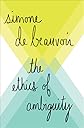
The Ethics of Ambiguity
Product ID: 241490823
Desertcart purchases this item on your behalf and handles shipping, customs, and support to India.
From the groundbreaking author of The Second Sex comes a radical argument for ethical responsibility and freedom. In this classic introduction to existentialist thought, French philosopher Simone de Beauvoir’s The Ethics of Ambiguity simultaneously pays homage to and grapples with her French contemporaries, philosophers Jean-Paul Sartre and Maurice Merleau-Ponty, by arguing that the freedoms in existentialism carry with them certain ethical responsibilities. De Beauvoir outlines a series of “ways of being” (the adventurer, the passionate person, the lover, the artist, and the intellectual), each of which overcomes the former’s deficiencies, and therefore can live up to the responsibilities of freedom. Ultimately, de Beauvoir argues that in order to achieve true freedom, one must battle against the choices and activities of those who suppress it. The Ethics of Ambiguity is the book that launched Simone de Beauvoir’s feminist and existential philosophy. It remains a concise yet thorough examination of existence and what it means to be human. Review: 10/10 - It was incredible Review: Excellente - Un trabajo de filosofía que da más sustancia a su trabajo del segundo sexo, recomiendo que lo lean junto a su novel "La invitada" también. Es interesante compararla con Sartre, hay similitudes y diferencias importantes.
| Best Sellers Rank | #50,135 in Books ( See Top 100 in Books ) #1,135 in Society & Culture (Books) |
| Customer Reviews | 4.6 out of 5 stars 911 Reviews |
P**T
10/10
It was incredible
K**T
Excellente
Un trabajo de filosofía que da más sustancia a su trabajo del segundo sexo, recomiendo que lo lean junto a su novel "La invitada" también. Es interesante compararla con Sartre, hay similitudes y diferencias importantes.
R**R
An authoritative text on existentialism
‘The Ethics of Ambiguity’ is one of the three authoritative philosophical short texts on existentialism, ‘The Myth of Sisyphus’ and ‘Existentialism is a Humanism’ are the other two. The ambiguity that Simone De Beauvoir discusses in this book is similar to the ambiguity that Sartre and Camus talk about; the ambiguity at the root of existentialism. In ‘The Myth of Sisyphus,’ Camus begins with the encounter with absurd, the encounter at the root of realization that the self cannot be reconciled with the universe. His argument on existentialism starts with a question on suicide and builds to explain the absurd, which once realized, he argues, should not be a source of anguish but bliss. In ‘Existentialism is a Humanism,” Sartre begins with the premise that ‘existence precedes essence’ and goes on to build an argument on why existentialism is the only doctrine that is humanistic. Within this argument, Sartre clarifies why existentialism is not individualistic but a philosophy that focuses on the greater good of the collective human race. In ‘The Ethics of Ambiguity,’ Beauvoir begins with the realization of ambiguity of existence around human condition, explores how childhood nurture contributes to this condition, investigates how freedom should be asserted in the face of this ambiguity (through a hierarchy of men based on how they react to the ambiguity) and concludes why existentialism is not individualistic but humanistic. “The continuous work of our life,” says Montaigne, “is to build death.” “Man knows and thinks this tragic ambivalence which the animal and the plant merely undergo,” Beauvoir argues, as she introduces ambiguity of human condition. The ambiguity is similar to Camus’ absurd – a realization that there is no universal meaning to human existence or action. Beauvoir goes on to investigate the source for humans’ belief in the universal nature of their actions. “Man’s unhappiness, says Descartes, is due to his having first been a child,” she quotes and explains how we as humans feel happily irresponsible as children, feel protected against the risk of existence but how the same happy ignorance makes us a prisoners of error in our adulthood. In other words, she argues that sooner or later every man realizes that the childhood he grew up with was a world created for him by his parents or adults and that in reality he is not bound to any universality of rules or ethics. He is free, free to will his own world, chart his own rules, yet he can only do that on the basis of what he has been – a child. “The child does not contain the man he will become, yet it is always on the basis of what he has been that a man decides upon what he wants to be,” she says. This freedom although should be liberating, ends up becoming a disturbing realization, one that lifts the veil of finite ceiling over man’s head and leaves him abandoned in the infinite world. In this abandoned anxiety, despite realizing his freedom, man tends to gravitate towards enslaving himself in the childhood condition instead of living freely. Beauvoir classifies this man into a hierarchy in order to build an argument to explain the true nature of existentialist freedom. The lowest man in the hierarchy is called a sub-man - a blind uncontrolled force that anyone can get control of. “The sub-man makes his way across a world deprived of meaning towards a death which merely confirms his long negation of himself,” she says. The attitude of sub-man passes over to the next class in hierarchy, what she calls the serious-man. While sub-man lives in a perpetual anxiety, the serious-man renounces his freedom to a cause. The serious man claim the absolute and ceaseless denies his freedom, “like the mythomaniac who while reading a love-letter pretends to forget that he has sent it to himself. He is no longer a man but a father, a boss, a member of a Christian Church or the Communist party. The serious man wills himself to be the God but he is not one and he knows it.” The attitude of serious-man transcends into the next category - the nihilist. The nihilist, unlike serious-man, under the burden of his freedom decides to be nothing, denies the world, himself and focuses on annihilation of the world. A nihilist who realizes the universal and absolute end which freedom is, further rises up in the hierarchy to become an adventurer. Adventures, she describes is an attitude closest to a genuinely moral attitude – an indifferent and disinterested encounter with the world that defines the true existentialist freedom. The adventures is perhaps Sisyphus – the man who is ceaseless rolling a stone to the top of the mountain, not in revolt but in lucid indifference. The same adventures though, she says also carries the seed of destruction and favorable circumstances are enough to transform an adventures into a dictator. However, she argues that if an adventurer turns into a dictator, he fails to assert his freedom and becomes a slave of tyranny, thereby inadvertently denies his own freedom. “Passion is converted into genuine freedom only if one destines his existence to other existences through the being – whether thing or man – at which he aims, without hoping to entrap it in the destiny of the in-itself,” she says and goes on arguing with elaborate detail on why the only way existentialism can exist, the only way a freedom can be asserted is by asserting it not for one but for all mankind. “A freedom which is occupied in denying freedom is itself so outrageous that the outrageousness of the violence which one practices against it is almost canceled out.” From explaining the ambiguity of existence, to its reason and reaction, Beauvoir ends with the argument that all this makes existentialism a philosophy that is not individualistic but a philosophy for the collective good, in other words, the ethics of ambiguity – the argument also at the center of Sartre’s ‘Existentialism is a Humanism.’ All in all, the book touches on the core principles of existentialism, tackles the absurdity of existence from a new direction, and gives the reader a novel perspective on the same principles. For anyone interested in understanding this field of philosophy, Beauvoir’s short but authoritative text should be a must in the reading list.
M**R
A Sometimes Challenging but Always Interesting Read
After spending some time reading Stoic philosophy, I decided to take a detour into existentialism. One of the first books I picked up was The Ethics of Ambiguity by Simone de Beauvoir. I didn’t approach the book from an academic angle; rather, I was curious about what existentialism had to say about how to live a meaningful life. At the end of Being and Nothingness, Sartre notes that an ethics of existentialism remained to be written. In the Ethics of Ambiguity, Simone de Beauvoir takes up the challenge of developing a system of ethics – how we ought to live - based on existentialist principles. I found the beginning of the book somewhat difficult to get through. Existentialism is grounded on several key concepts, such as facticity and bad faith, which have specific meanings that are essential to grasp in order to fully appreciate de Beauvoir’s arguments. The book was also originally written in French, so perhaps some of its readability may be affected by the translation into English. However, after the first chapter, I found the book easier to follow. The discussion turned to more concrete ideas, such as the different ways people respond to the ambiguity inherent in human freedom (e.g., the sub-man, the serious man, the nihilist, etc.). Despite often being abstract, I found The Ethics of Ambiguity to have some interesting insights into human freedom and responsibility. De Beauvoir argues that we must accept the ambiguity inherent in our freedom by creating our own values and meaning through action and engagement with the world. Moreover, true freedom involves not only taking responsibility for our own freedom but also working to promote the freedom of others. Therefore, our actions and the projects we take on must respect both our own personal freedom and that of others. Is existentialist philosophy worth reading? Interest in existentialism seems to have declined in academic philosophy. It can also be criticized for being abstract, difficult to apply practically, and written in a dense, intellectual style that can be challenging for non-academic readers. Still, I believe there is value in its message of the need to take responsibility for one’s own freedom by creating meaning through action and deliberate choices. Personally, however, I find more value in reading Stoic philosophy due to its relative ease of understanding, its emphasis on developing internal character, and its focus on controlling what we can while accepting everything else with equanimity. For those new to existentialism, I recommend finding an edition of this book that has a preface or introduction by an expert providing a general overview of the key concepts of existentialism. Such an introduction would help readers new to existentialist thought better understand and appreciate de Beauvoir's arguments.
A**E
Translation makes it hard to understand
While I am able to wrap my head around the presented ideas, the quality of the translation makes it hard to understand some of the text. Not being a native English or French speaker, I have difficulties with the sentence structure sometimes. First I thought I have to blame myself for not being able to understand more complicated philosophical writing but the grammar is also not entirely correct all the time and some sentences are unnecessarily long. (If you find any mistakes within this review: I am sorry, and I don't mean any harm and I don't mean to be a hypocrite. Just warning people who - like me - rely on very clear sentence structure).
C**E
Great read
Insightful and we'll written
Trustpilot
2 weeks ago
1 month ago