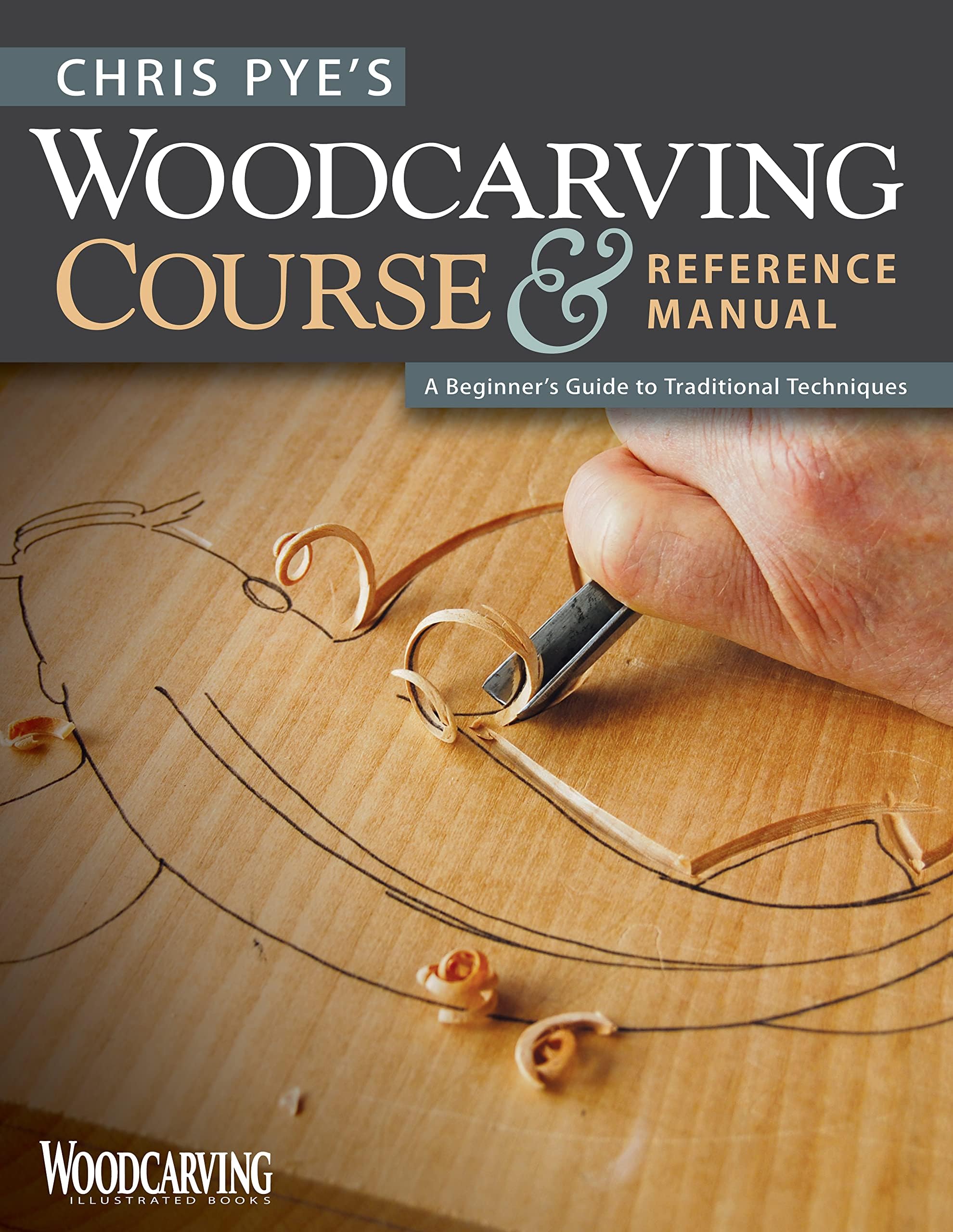
Chris Pye's Woodcarving Course & Reference Manual
Product ID: 4147650
Desertcart purchases this item on your behalf and handles shipping, customs, and support to India.
A comprehensive guide akin to having a one-on-one course with a master carver! Learn step-by-step : Clear instructions and color photos take you through every step of the carving process, from grips to simple exercises to practice projects for carving in the round Workbench, tools, & wood : Learn the details of what to look for in a workbench and its accessories; what tools are available, what they each can do, and which ones you need to get started; and how to choose the best woods to carve Commission & sharpen : Learn how to commission your carving tools from gouges to bevels—simply being sharp is not the whole story Exacting cuts : Learn how to safely make precise cuts with your tools using different grips and angles, including running cut, stabbing cut, stop cut, sweep cut, slicing cut, and more Practice exercises : Learn how to execute a variety of techniques by applying what you've learned to various practicing activities designed to get you comfortable with using your new woodcarving tools correctly Relief and in-the-round projects : Step-by-step, you'll learn how to carve in low relief, high relief, and pierced relief, as well as a wren and a baseball cap in-the-round The first step into a new craft can be overwhelming: Where to start? What tools to buy? What projects to begin with? Thanks to author and internationally acclaimed woodcarver Chris Pye, this guide is filled with everything a beginning woodcarver needs to know. Chris Pye's Woodcarving Course & Reference Manual is akin to having a one-on-one course with a master carver. You'll learn what to look for in a workbench, the importance of commissioning your carving tools—there's more to it than just sharpening!—and how to make exacting cuts and execute a variety of techniques. Like any good instructor, Pye includes practice exercises to make you comfortable with the tools and techniques so you can build your skills and carve with confidence. His warm, conversational teaching style will encourage you as you follow the step-by-step instructions and work on a number of motifs, as well as projects for low, high, and pierced relief, and in-the-round. This resource is a collection of tips and tricks honed over many years, and will mentor newcomers and serious beginning woodcarvers alike. Novice crafters will find quick success and encouragement working on a number of carving motifs and three projects for both relief and in-the-round styles. For serious beginners eager to know more about a timeless craft, this go-to reference provides an answer to every question. With the help of Chris Pye's Woodcarving Course & Reference Manual , you'll learn to carve: Four types of simple, decorative molding Designs, symbols, and letters in the traditional relief style Several forms of line carving, including cavo relievo Beautiful koi projects in three levels of relief A realistic baseball cap in-the-round A charming wren in-the-round


| Dimensions | 8.5 x 0.4 x 11 inches |
| Edition | First Edition |
| Isbn 10 | 1565234561 |
| Isbn 13 | 978-1565234567 |
| Item Weight | 2.31 pounds |
| Language | English |
| Part Of Series | Woodcarving Illustrated Books |
| Print Length | 160 pages |
| Publication Date | October 1, 2010 |
| Publisher | Fox Chapel Publishing |
User
Woodcarving at its Best!
Chris Pye is one of the very best woodcarver's I have ever seen. I have several of his books and jumped at the chance to get this one. If you are considering going into woodcarving either professionally or as a hobby, I would recommend purchasing one or all of Chris' books! He covers all aspects of what tools to buy, how to sharpen them, and most importantly how to use them. There are lots of great photos in this book as well. Very pleased with this purchase,
User
EXCELLENT book for a seasoned artist new to woodcraft. A must buy!
I've purchased more how-to book than I can count over the decades, but I've never once made a project from within because as an artist, I want to do my own work not what someone else has done. I just want to familiarize myself w/ the tools and techniques in the books. So many beginner books are really RAW beginner. More for crafty people (nothing wrong with that, it's just a different audience) than seasoned artists looking to expand their knowledge and mediums. THIS book is for the artist. You don't have to be for sure, but it appeals to me because speaks to me with intelligence and not like I've never held a brush or tool in my life that so many beginner books do. The projects here are sophisticated but simple. Someone with real fine art background will appreciate them and this book very much. I couldn't be happier that I immediately had to write a review assign as I finished reading it.
User
A great resource for a beginner
This book is packed great information, pictures that do a good job of illustrating the topic at hand and examples of beautiful, inspiring work.My only complaint is that certain parts are a little too brief. I feel that the section on sharpening withholds too much information... and then encourages you to consult (i.e., buy) the author’s book on the topic to find out more. Instead, I would recommend checking out YouTube and his site. Although, when it comes to sharpening, I highly recommend Popular Woodworking’s The Perfect Edge. Carving tools are only one section in that book but there is so much great information that workworkers should know about.
User
buy this
This book is an excellent place to start from. The author was able to make a book that is well written and has easy to follow instructions and pictures.
User
A very good -- if intimidating -- guide for the beginner.
Chris Pye is one of the best-known teachers of modern woodcarving and in this book he shows you how -- more-or-less.Woodcarving in the classic manner is scary looking from the outside. In addition to the enormous number of tools, there is the matter of learning the many techniques. Pye doesn't so much de-mythologize all this as lead you through it by the hand.Take the tools, for example. Pye illustrates and explains a couple of hundred of the more common ones, but he also points out that the beginner doesn't need more than 6 or 8 basic tools and most woodcarvers will never touch most of that vast array in their careers.With the tools described, Pye moves to the heart of woodcarving, sharpening and preparing the tools for use. A serious carver will spend at least as much time sharpening and honing as she does using the tools. Properly sharpened tools make all the difference in the world and Pye devotes considerable space to showing you how it's done.Unfortunately sharpening is something that has to be learned by practice and most beginners end up working with improperly sharpened tools because they haven't mastered the art. This makes everything harder an seriously limits what you can do. BTW: woodcarving tools come with an edge on them, but they are not properly sharpened. Each tool has to be sharpened and honed before it can be used to do anything but hack and tear at wood.Pye is English and this shows in the selection of woods he discusses. Some of them are not common in the US.Then we get to the carving projects. Since Pye is a carver in the classical tradition the projects concentrate on relief and three-dimensional projects. They are definitely interesting -- I particularly liked the banana peel -- but they are probably a little much for beginners.All in all, a very good book to get you started.
User
As good as a 2-dimensional woodcarving book gets!
This book gives a really good foundation with information about tools, types of wood, and different methods of carving, as well as projects & patterns to help you get started. Chris Pye is (in my opinion) an amazing craftsman and artist, and even if you don't carve, looking at the photos of his process and the finished pieces is a great experience. The only thing better would be if the book came with an instructional DVD of some kind, because it can be challenging to make sense of a 3-d or "in the round" project from written instructions and photos. I would absolutely recommend this book for anyone interested in learning more about carving!
User
Top-notch Reference on the Subject
This writer is quick to give credit where it is due. He is not afraid to direct readers to other individuals, suggest additional resources, and refer readers to online videos. He is foremost a teacher who wants others to learn--not primarily concerned with referring to his other works just to turn a buck. This writer is foremost in his field--but is said to be so by others rather than self-promoting. This text is said by many to be the best introduction to the hobby of carving......I would wholeheartedly agree. If you could only get one book on the subject--get this one.
User
Old Carvers Need More Black And Less White
Well written book by an expert carver. However, I am an old guy and my eyesight isn’t what it used to be. When I pick up this book I have evil thoughts about a publisher that uses such a small font, leaving so much white space, either in the margined or between the lines. A small increase in the size and boldness of the font would make the book much more enjoyable to read. The illustrations are excellent. The book layout is very beautiful, but very difficult for old eyes to read.
User
Good information and easy to follow.
Arrived on time and in good order, excellent reading
User
Très bon livre
Bonjour,J'étais à la recherche d'un livre traitant de la sculpture sur bois pour débutant. Partant de zéro, il me fallait un livre qui m'explique au moins :- les outils de base qu'il faut acheter pour débuter- comment les aiguiser et les entretenir- les techniques de sculpture de base, et si possible quelques examplesJ'ai donc comparé les livres suivants pour débutants (en français et en anglais) :1) Woodcarving course & reference manual, a beginner's guide to traditional techniques; Chris Pye2) Relief carving in wood, a practical introduction; Chris Pye3) Manuel de sculpture sur bois, technologie et initiation; Jean-Pol Gomérieux4) La sculpture sur bois, techniques et réalisations; Medina Ayllon et Eva Pascual5) Wood carving, projects ad techniques; Chris Pye6) Sculpture sur bois, Antoyny DenningJ'ai également parcouru le livre suivant, qui n'était visiblement pas pour débutants (j'aurais dû m'en douter, vu le titre) : "Manuel de sculpture sur bois, perfectionnement et modèles", de Jean-Pol Gomérieux. Il est à noter d'ailleurs que ce livre traite avant tout de l'histoire de l'ornementation (plus de la moitié du livre). Il y a quand même quelques exemples, mais pas en suffisance. De plus, il ne s'agissait pour la plupart que de pieds de tables et autres de style très ancien.J'ai mis les livres ci-dessus dans l'ordre de mon appréciation. Je recommande avant tout le 1), 2) ou 3). Pour l'aiguisage des outils, je recommande également le livre de Freidrich Kollenrott (en anglais ou en allemand, pas en français).J'ai préféré les livres 1) et 2) aux autres. Ils sont du même auteur (Chris Pye) et ils sont assez semblables. Il faudrait donc choisir l'un ou l'autre. Je trouve que la partie introduction (outils, aiguisage, technique) est un peu mieux expliquée dans le livre 1), par contre, pour ce qui des exemples à travailler, je préfère le livre 2). Dans le livre 2) il n'y a que deux exemples qui sont très développés. Dans le livre 1) il y a bien plus d'examples, mais l'auteur ne décrit pas les étapes dans les mêmes détails que dans le livre 1). Le livre 1) est édité sur des pages brillantes, le livre 2) est imprimé sur du papier "normal". Les deux livres proposent une sélection d'outils de coupe pour débuter (10 à 11 selon le livre).Le livre 3) est très complet, une édition luxueuse également. Ce livre n'étudie que la sculpture en relief (pas en ronde-bosse). C'est aussi le seul des livres qui traite des racloirs; l'auteur propose même d'en faire soi-même et sur mesure. Comme le livre 2), il y a un nombre réduit d'exemples (deux), mais qui sont élaborés très dans le détail. Je préfère cela à des livres qui donnent plein de beaux exemples, sans montrer comment les faire pas à pas. Dans ce livre 3), beaucoup des illustrations sont des photos retravaillées par ordinateur ou des dessins faits sur ordinateur pour que les images soient faciles à comprendre. Cela rend les choses plus claires d'un côté pratique, mais du côté esthétique, on aime, ou on n'aime pas (moi j'aime moins). L'auteur propose également une sélection d'outils de coupe pour débuter (un peu plus de 30, ce qui à mon avis, est déjà beaucoup pour débuter). L'auteur nous montre comment aiguiser à la machine (ce qui n'est pas le cas des livres 1) et 2)) et aussi à la main (ceci, par contre, est mieux expliqué dans les livres 1) et 2)).Le livre 4) donne un bon aperçu de tous les différents outils de coupe, mais ne recommande pas une sélection pour débuter. En fait, pour l'aperçu des outils, je n'ai pas appris plus que ce que je n'aurais pu trouver sur le site de l'un des producteurs de ces outils. L'aiguisage est expliqué, mais pas suffisamment dans le détail. Les exemples sont nombreux (et donc pas peu détaillés) et trop compliqués pour des débutants.Le livre 5) est celui des trois livres de Chris Pye que j'ai le moins apprécié. Il ne propose pas de sélection d'outils. Il ne parle que des burins droits ("V-tool") dans la partie introduction/technique. Malgré tout, l'entretien de cet outil est bien expliqué, surtout l'affûtage, qui est montré dans tous les détails. Il y a beaucoup d'exemples, mais ils ne sont pas bien expliqués et sont d'un niveau trop compliqué pour un débutant.Le livre 6), est le livre que j'aimais le moins. La raison: son format "2 livres en 1". Il faut s'imaginer que les pages sont coupées en 2 horizontalement. La partie supérieure (le haut de la page) est un livre qui couvre les différents exemples. La partie inférieure, elle, contient l'introduction/la technique. La partie technique est donc à lire dans un livret d'environ 20 cm de large sur 10 de haut. C'est assez ennuyeux et on perd vite la structure du livre.Les outils sont expliqués, mais il n'y a pas de sélection proposée pour débuter. Une note positive pour terminer: il y avait quelques très belles oeuvres dans les exemples proposés (et qui plus est, elles étaient abordables pour un débutant).
User
A detailed and straightforward guide.
An excellent book. I've taken my copy straight to the workshop.
User
Totally recomended
Master teacher! This book can take you from the beginning of carving to becoming a more experienced carver.
User
Helpful information and well laid-out in the book
Easy to read and understand. Worth purchasing for a beginner or if it is just something that you are interested in trying before buying all the equipment needed.
Trustpilot
2 months ago
4 days ago