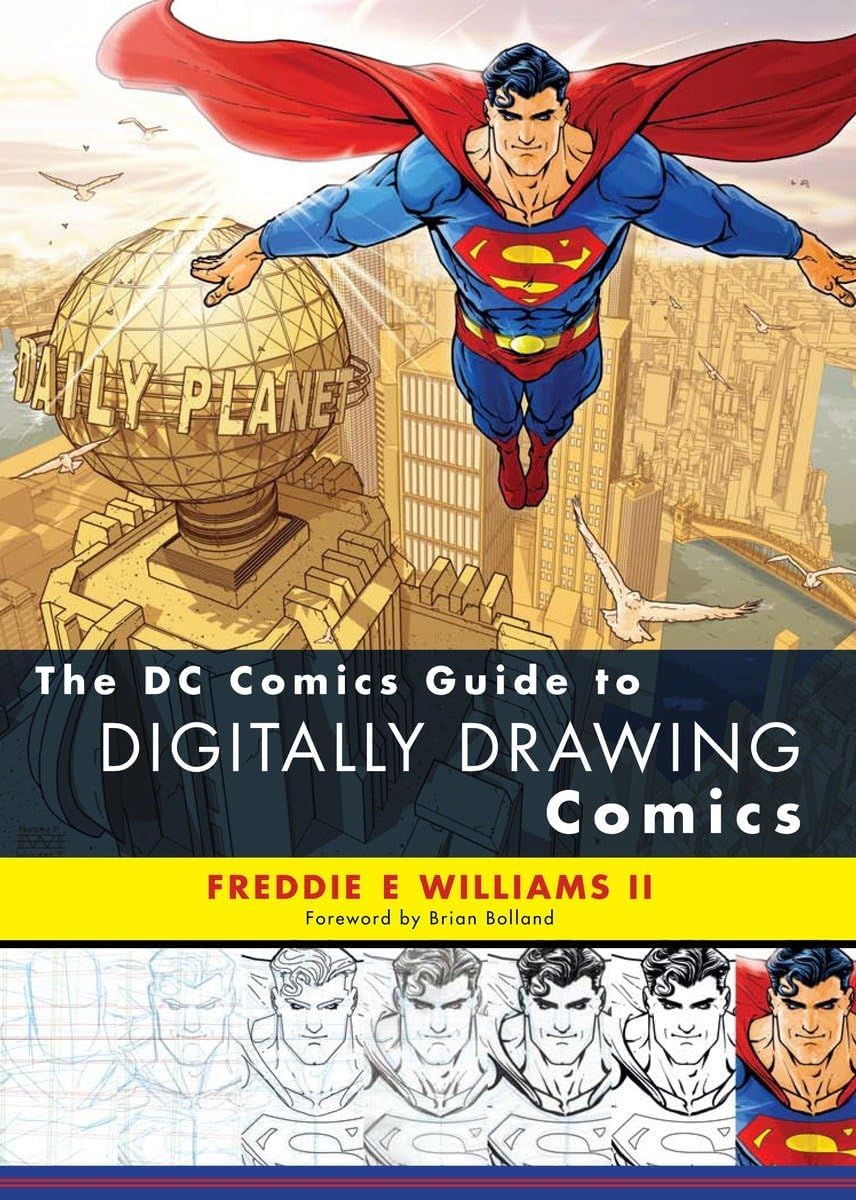
The DC Comics Guide to Digitally Drawing Comics
Product ID: 48915754
At last-the first guide to drawing comics digitally! Artists! Gain incredible superpowers...with the help of your computer! The DC Comics Guide to Digitally Drawing Comics shows how to give up pencil, pen, and paper and start drawing dynamic, exciting comics art entirely with computer tools. Author Freddie E Williams is one of DC Comics' hottest artists and a leader in digital penciling and inking-and here, in clear, step-by-step directions, he guides readers through every part of the digital process, from turning on the computer to finishing a digital file of fully inked comic art, ready for print. Creating a template, sketching on the computer, penciling, and finally inking digitally are all covered in depth, along with bold, timesaving shortcuts created by Williams, tested by years of trial and error. Step into the digital age, streamline the drawing process, and leap over the limitations of mere physical drawing materials with The DC Guide to Digitally Drawing Comics . Review: A MUST! - This book is a must! Unless you want to keep doing every stage of a comic book in the old-fashioned/traditional way, you must have this book. Many books promising to reveal all the knowledge about this or that - but many times I find that "Yeah, I can take some knowledge out of it... like 15% or something... all the rest is just useless..." - but not this one: Freddie E. Williams II just opens a golden door to deep knowledge. From creating folder trees to comics templates, different workflows and how to incorporate them, tips on scanning, tips on rendering, tips on Photoshop ( the layer template for each comic page is great - I use it and works like charm for me ) . I even got the will to try a full digital workflow BECAUSE of this book. I love pencils, so I'm following the "Pencil hybrid workflow" but I'm trying to find a project that allows me to try the full digital. All its there, I think this is the best book on the subject. The title says what you will find inside - unlike The DC Comics Guide to Pencilling Comics (Freddie recommends this one at some point..) but I found that one really disappointing... "The DC Comics Guide to Digitally Drawing Comics" is by far the best book I've read (and continuously keep reading) on the subject! 10 start! Oh damit... only 5 allowed! Review: For Photoshop, non-beginners... 5 stars. - The book focuses on the method of producing a digital comic book rather than drawing techniques. There are lots of other 'How to draw' books to help depending on what style you want to use. The tips, tricks and digital/pencil hybrid processes are brilliant and explained superbly. The underlying techniques can be used with other image software but the book relates to Photoshop. It's not the magic key for producing digital comics (if there is one I'd like a link to it please) but it will put you in a much better position to create good-looking comics quicker. The book is aimed quite high so beginner's might struggle although it might teach good habits sooner.
| Best Sellers Rank | 639,667 in Books ( See Top 100 in Books ) 102 in How to Create Comics 404 in Figure Drawing 417 in Digital Art |
| Customer Reviews | 4.6 out of 5 stars 227 Reviews |
M**き
A MUST!
This book is a must! Unless you want to keep doing every stage of a comic book in the old-fashioned/traditional way, you must have this book. Many books promising to reveal all the knowledge about this or that - but many times I find that "Yeah, I can take some knowledge out of it... like 15% or something... all the rest is just useless..." - but not this one: Freddie E. Williams II just opens a golden door to deep knowledge. From creating folder trees to comics templates, different workflows and how to incorporate them, tips on scanning, tips on rendering, tips on Photoshop ( the layer template for each comic page is great - I use it and works like charm for me ) . I even got the will to try a full digital workflow BECAUSE of this book. I love pencils, so I'm following the "Pencil hybrid workflow" but I'm trying to find a project that allows me to try the full digital. All its there, I think this is the best book on the subject. The title says what you will find inside - unlike The DC Comics Guide to Pencilling Comics (Freddie recommends this one at some point..) but I found that one really disappointing... "The DC Comics Guide to Digitally Drawing Comics" is by far the best book I've read (and continuously keep reading) on the subject! 10 start! Oh damit... only 5 allowed!
T**G
For Photoshop, non-beginners... 5 stars.
The book focuses on the method of producing a digital comic book rather than drawing techniques. There are lots of other 'How to draw' books to help depending on what style you want to use. The tips, tricks and digital/pencil hybrid processes are brilliant and explained superbly. The underlying techniques can be used with other image software but the book relates to Photoshop. It's not the magic key for producing digital comics (if there is one I'd like a link to it please) but it will put you in a much better position to create good-looking comics quicker. The book is aimed quite high so beginner's might struggle although it might teach good habits sooner.
C**C
Good in parts
Good in parts, not as good in most parts. Google Sketchup is in common use in most comic books these days and while the author clearly uses it a lot, he only has one page on it (the last page of the book). Otherwise it is useful for telling you how to layout a bristol board page with guides and rulers so there are definitely good parts to this book
G**H
A great industry-specific title
A great, succinct introduction to digital drawing. It's very much American professional comic industry oriented, with should come as no surprise, but keep in mind it doesn't go into detail on how to draw digitally. It does a great job of covering techniques for streamlining the process of comic drawing with a guide to some useful tools and techniques. Again, this is a very different process to digital painting, doing covers etc. This is for those interested in doing comics in the old pencils-inks kind of way. It doesn't cover colouring, but DC has released a very decent intro to that separately.
S**M
brilliant
has some great tips and techniques in the book - ideal for anyone starting out in cartooning. but you will need to have a graphics tablet to make the most out of the book.
A**L
A good introduction into digital comics
Good delivery service. A good and informative book, well written, I've gone through this book a few times and I keep it near by
J**N
Five Stars
A brilliant and helpful book
N**B
Useful
Useful. No drawing lessons at all, just Photoshop methodology. If you wish to use Manga studio, then you will need to get a different guide, but this may still be useful in helping you to "think digitally". For 12 quid you can't really go wrong!
R**I
Exactly what I needed
I'll withhold an in-depth review here until I've actually gotten past reading and done some work using these methods (see edit below), but having read the book I'm very happy with it. The tone is definitive, sidestepping the usual apologizing for personal idiosyncrasies in favour of explaining practical methods clearly. Much appreciated! The subject here is producing comic-book line art either completely or partially on the computer; there's no clutter about lettering or colouring or even the subject of sequential storytelling itself. For an old-fashioned illustrator who hasn't been so sure about that transition from conventional tools to digital, it was a relief to learn that the artist is actually working in RGB mode with anti-aliased brushes. I've done some work in pure vector because of the scaling issues of raster graphics and downright fear of anti-aliasing in line art for print. That was anything but a time-saver. Just having those foolish notions dispelled was worth the price of this book (and here I am spoiling it). But there is much more here. The book only begins with the bare bones of Freddie Williams II's workflow (with a few variations), and goes on to a number of specific techniques geared to actually saving time over conventional methods. That's a big concern. As I mentioned, I've found that digital methods can slow down production. For instance, if you are familiar with conventional brushes and pens, even the best Wacom tablets can feel sluggish and limiting. The author has methods here that clearly help to balance against that hindrance, and also provides a number of techniques that save buckets of time (his perspective line reference layers alone stand to save tons of time and make any illustrator less prone to faking or avoiding it). On the downside, I'm not buying that the methods outlined are applicable to just any graphics software. In fact, there are a lot of vector stroking techniques that have no viable equivalent in most paint programs. I'm somewhat familiar with most of these programs, and don't expect comparable results with anything short of Photoshop, or possibly Photopaint (I wish it weren't so). *update: Having really gotten into this I can verify that Freddie Williams' methods are highly geared to Photoshop. But I can also report that he is actually working to Photoshop's particular strengths. For example, as versatile as Photoshops brush system is, it's brushes are a bit fidgety compared to real ink on a brush (or pen) -- especially if you aren't working with the most high-end tablet on a very fast machine. Photoshop's lasso selection tool, however, is truly amazing in its speed and control. So Mr. Williams actually does much of his "inking" with the lasso tool. Unfortunately, because some lines are lines, he also relies on stamping methods to duplicate clean brush strokes for hatching/feathering and other repeatable instances. While I am sure these methods feel fast to someone who has done a lot of manual line work in Photoshop (fighting with the brush and hammering the undo key), I find it slow and tedious compared to inking such things naturally with a brush or pen. So I'm torn. Photoshop is awesome software and can do so much more, but it is not entirely the best choice for simulating comic-book style line art. Freddie Williams has developed a system that makes the best use of Photoshop for these tasks. He also works in the mode of a production artist, getting the most use out of everything generated. But if I didn't own the software already, it would be a hard sell. If you are looking at this and haven't already bought in on any software, it's worth grabbing the demo versions of Painter and Manga Studio as well for comparison. This book may still sell you on Photoshop, but if you're more inclined to going at every page fresh and 'inking' with your natural style than developing and arranging re-usable elements, it may not. Or you may want to take a bit from here and a bit from there and come up with your own "hybrid" digital workflow. In any case, buy this book.
S**R
Fantastic Book
Freddie E Williams II Breaks down his process in an easy to follow step by step Process of how to create a comic book, It doesn't get much better than this. actually ive even added some of his process to how i develop my pencil work as well. This book is so helpful the only thing better would be to have Freddie personal at your side guiding you through the whole process. But the book is so clear and easy to fallow it almost seems like he is there sitting beside you. If you want to work like a pro and improve and stream line your work flow and meet your dead lines this book is for you. Love this Book!!!!!
S**R
cool time saving shortcuts
most helpful book on producing comic art digitally. It has every topic covered- creating the master page template, arranging workspace, creating photoshop actions, time saving libraries, cardboard cut outs, emphasis lines, Backgrounds, special effects, cool time saving shortcuts, layout, & ofcourse the Digital workflow of creating black & white comic art, which helped a lot for an artist like me who ventured out in digital art world for first time. I had no idea of creating comics on computer. but After 3 days, when i finished reading this book, I was confident enough to create an entire book. HIghly recommended for artists of traditional media who also want to explore the world of digital comic making Important: this book deals only with photoshop. although author worked on version CS3 at the time this was published, but it doesn't make any difference. all those options are available in recent versions of photoshop (obviously).
M**N
Ce n'est pas un livre pour apprendre à dessiner !
Je viens quelque peu contrebalancer le commentaire précédent en précisant qu'il ne s'agit absolument pas d'un livre pour apprendre à dessiner. Au contraire il s'adresse davantage au professionnel (ou au débutant grandement avancé) qui souhaiterai apprendre à manier Photoshop pour la réalisation d'une bande dessinée, et là-dessus le livre remplit grandement sa fonction. Freddie E Williams décrit ici sa propre méthode de travail (ce qu'il nomme rough, wireframes, inking, etc) et nous livre certaines astuces pour optimiser sa production. Cependant on pourra trouver ces méthodes un peu trop singulière dans la mesure où chacun possède sa propre manière de dessiner ou d'encrer, qui ne correspondra pas forcément à celles décrites ici par l'auteur. Néanmoins je recommande la lecture de ce livre pour toute personne souhaitant dessiner numériquement. Je le répète : vous n'apprendrez pas à dessiner avec ce livre !!
A**D
Great book for getting started in digital art.
Great book detailing work flow for digital comics. Author has said that he has since updated his work flow - wish he would share it in a downloadable format.
Trustpilot
1 month ago
1 day ago