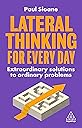
Lateral Thinking for Every Day: Extraordinary Solutions to Ordinary Problems
Desertcart purchases this item on your behalf and handles shipping, customs, and support to India.
Description
💡 Transform ordinary problems into extraordinary solutions!
- BOOST YOUR INFLUENCE - Become more persuasive and convincing by applying powerful reasoning strategies.
- PRACTICAL ENGAGING - Packed with puzzles, examples, and challenges that sharpen your problem-solving skills.
- PERFECT FOR NEWCOMERS - An accessible guide designed to shake up your thinking and spark original ideas.
- LEARN FROM VISIONARIES - Draw inspiration from icons like Elon Musk and Lady Gaga to fuel your creative mindset.
- THINK BEYOND THE OBVIOUS - Master lateral thinking techniques to solve everyday challenges with fresh, innovative approaches.
Lateral Thinking for Every Day by Paul Sloane is a practical guide that teaches you how to apply creative, indirect problem-solving methods. Featuring inspiring examples from renowned innovators and engaging puzzles, this book helps readers develop fresh perspectives, enhance persuasion skills, and tackle everyday challenges with innovative solutions.

Specifications
| Dimensions | 15.49 x 2 x 23.01 cm |
| Edition | 1st |
| Isbn 10 | 1398607940 |
| Isbn 13 | 978-1398607941 |
| Item Weight | 1.05 kg |
| Language | English |
| Print Length | 247 pages |
| Publication Date | 3 Jan. 2023 |
| Publisher | Kogan Page |
Reviews
User
Item as advertised.
Item as advertised.
User
Lateral thinking for every day
This book for the general reader hopes to shake up thinking and get some new answers to knotty problems. We are given examples from real life, of creative suggestions starting businesses. There are many puzzles which help us to provide a lateral thinking solution. You will have come across some in the past and others will be new. Answers may occur to you which are not given in the book, which shows there can be more than one solution.We're also led to consider business meetings, conferences and the like, with or without online streaming of participants. When lockdowns started, Zoom meetings became the lateral thinking solution. Keep flexible, keep being an individual.I enjoyed the read, it is a little simplistic for me but would serve well for someone new to the topic.I read an e-ARC from Fresh Fiction and Net Galley. This is an unbiased review.
User
a poor mash of ideas from other books
I feel like I have just read a summary of other, much better, books on creative thinking. There is nothing original or new in this book just endless snippets and quotes from others. If you want a lazy journey through creative and lateral thinking then this is your book.
User
A Pratical Approach to Solving Problems
This a book that challenges the mind and helps in the solving of everyday problems. It is a refresher and reminder of how to engage our minds to produce radical results for solving problems.Paul’s style of writing is helpful to the reader, as he uses short chapters to illustrate how you can use lateral thinking in all aspects of work and your everyday thinking. He examines the dangers of conformity, group think and conventional thinking in your decision making, and show how thinking outside the box can produce interesting results.For example, we all get stuck from time to time in things we want to achieve, at home, at work or at play. Momentum has stalled and it is difficult to fire it up again. In one short chapter (32) Paul presents a ten-step plan to get you motivated, simply written and easy to follow.Thus, the book is for everyone, with many practical ideas, and case studies introducing you to new ways of thinking when you are faced with problems to solve, and helps you to think differently.The Book was discussed by the CSNet Book Discussion Group in July 2023.
User
A great intro to Lateral thinking
I gave this book to my 18 y.o ahead of starting his engineering degree as lateral thinking is key. He said; It was very good, it taught me many new ways of generating ideas, as well as giving multiple methods for making those ideas better. Some of the riddles and lateral thinking puzzles in the book are a bit of stretch which I don't think many people would get, even if they are well-versed lateral thinkers but overall it was a great introduction to Lateral thinking.
User
A Brilliant Book
Previously, Paul Sloane's excellent books concentrated on very enjoyable lateral thinking puzzles. Now he has turned his attention to the use of lateral thinking in everyday life to help solve practical problems and succeed in virtually every area ⁸of human activity.His new book has sections on business, work, science, history, architecture, innovation, games, humour, marketing, mathematics and literally dozens of other areas of life.I challenge anyone to read this book and not come away with many new lateral ideas that can be applied to everyday situations. A great book bursting with new ideas, that can be thoroughly recommended.Anne MacHale.
User
A reminder of how important it is to think openly - and practical techniques to help you do it
We hear a lot about social media and other 'echo chambers', where existing opinions, beliefs and behaviours are reinforced by repetition and the absence of challenge or exposure to opposing views. This book is a timely reminder of how important it is to avoid the negative consequences which can result from such limited thinking and engagement. Some of the examples, and the practical techniques to stimulate creative or lateral thinking, will be familiar to many readers, but you are sure to find new ones here, too - all presented in an engaging and highly readable form.
User
Don't scratch your head to be different
Don't scratch your head to be different; just use Paul Sloane's latest offering. That was my initial view; having now read it in full, at length, it is remarkable and helpful in business and in life generally. Bravo Paul!
User
Lateral thinking for every day: Extraordinary solutions to ordinary problems
Takeaways from reading the book:Ask questions to people- Pages 5 and 26: The question "What if...?" helps to think of new possibilities and challenge assumptions.- Page 106: What do you need to feel happier with our products and services?- Page 106: What would make you smile when you hear our name?- Page 106: What things that irritate people do we need to get rid of?- Page 143: What would users / customers like to do themselves?- Page 146: How can we renew the purpose of a product? An example: Mobile phones are no longer primarily phones. They have numerous other purposes.- Page 171: What idea from one field can you use in a completely different field?Observe what people doPage 147: What do users / customers use the product, service or app for? What needs to they satisfy by using the product, service or app?Walk around and collect ideasPage 159: The most creative people are people who go around and collect ideas from lots of different people, play with them and bounce them off of other people.Follow needs that people have- Page 17: Founders of Airbnb discovered a need people had to 1) rent their homes out to other people and 2) rent homes of other people. Airbnb is a digital platform that makes it possible for people with the 2 needs to help each other. Airbnb does not own homes people stay at.- Page 31: In 1831, Tiffany was started by Charles Tiffany and John Young in Brooklyn, Connecticut, USA as a stationery and fancy good store. In 1862, during the US civil war, Tiffany supplied the Union army with swords, flags and surgical implements. After the war, Tiffany focused on jewelry. Tiffany is now renowned for its luxurious goods and stores. In 2021, Tiffany was sold to LVMH.- Page 31: Avon was founded by David McConnell in New York in 1886. Initially, Avon sold books door to door. McConnell gave perfume samples as an incentive for book sales and found that demand for perfume exceeded the demand for books. He went on to focus on perfume and cosmetics and built the company based on Avon ladies selling perfume and cosmetics directly to customers.- Page 182: Find out what needs a manager, whom you want to sell your ideas to, has. Is she / he motivated by pride, ego, money, career advancement, recognition or something else? Does she / he make decisions using numbers, trusted sources, evidence, avoidance of risk, logic or emotion?Analyze the problem- Page 75: Example: Analyze the time it takes to build a building. Find out in which process steps there is improvement potential.- Page 77: 6 serving men method: What, why, when, how, where, who. Examples: What is good healthcare? Who provides good healthcare? Etc.- Page 110: If you get stuck doing something you have started doing, ask why you got stuck. Find the main reason. Then redefine the goal.Rearrange- Page 76: To what extent can you rearrange the phases for doing a task and achieve better results.- Page 159: Try rearranging spaces and/or furniture to strengthen certain values. Example: Taking out chairs from meeting rooms will reduce the length of meetings.Develop ideas- Page 95: Linus Pauling, a scientist, who won two Nobel prizes in two different fields, said, "The way to get good ideas is to get lots of ideas and throw away the bad ones."- Page 96: Toyota generates 2 million ideas every year. 90% are implemented.- Page 85: Random word method: 1. Select a problem to solve. 2. Pick a random word and list 5 associations with the random word. 3. Use the six words to develop ideas which can help solve your problem.- Pages 101 and 131: To get many different questions and ideas, invite people, who are different from each other. Increase diversity.Communicate ideas to peoplePage 185: Make suggestions to people that you think can be useful for them.Test ideas- Page 35: When Swedish physician Per-Ingvar Brånemark was researching bone marrow, he implanted a piece of titanium into the leg bone of a living rabbit. After some time, he tried to remove the piece of metal and found that it had become fused with the bone. Before this, the fusion of titanium and bone had been an unknown biological process.- Page 102: Test ideas in inexpensive ways.- Page 193: Thomas Edison carried out thousands of experiments.Accept mistakes and improve- Page 40: Many children, who learn to ride a bicycle, fall off the bike a few times. They learn from their falls by getting up, adapting their way of cycling and trying again. Falling off the bike is a natural source of learning and improvement.- Page 195: A tennis player is prepared to lose some points as double faults, if it means that most of the time his or her serves are difficult to return.- Page 197: Share what you learn from mistakes and use learnings as starting points for improvements.Be curious about the unexpected- Page 59: In the early 1940s George de Mestral went for a walk one day with his dog in the Jura mountains in Switzerland. When he came back, he discovered that his trousers and the dog's furs contained tiny seed burrs. He examined the burrs under a microscope and saw that they had tiny hooks. This was the start of Velcro, an innovative way to fasten materials.- Page 150: As students, Google founders Larry Page and Sergei Brin worked on analyzing links on the Internet. They were building a web analysis tool. Page later said that at that time, he had no thought of building a search engine. Over time they developed a method, which gave greater accuracy in assessing the relative importance of sites.Copy ideas- Page 171: Henry Ford copied the idea of the assembly line in car manufacturing, after he saw it in a meat packing factory. Later, Ray Kroc copied the idea and used it in McDonald's.- Page 171: Danish architect Jørn Utzon based the design on the Sydney opera house on the sails of sailing boats.- Page 171: Chemist Helen Barnett Diserens copied the idea of a ballpoint pen and adapted it to create the roll-on deodorant.Combine ideas- Page 59: In 1908 in New York a tea merchant sent customers samples of tea leaves in small silken sachets to try out. Customers were supposed to empty out the contents. Instead some put the whole tea bag into the teapot and added hot water. The teapot is one of the most important inventions of all time.- Page 61: In his book Inventology, Pagan Kennedy explains that inventors are able to bring together knowledge from different fields as they create something new.- Page 179: To create the printing press, Johannes Gutenberg combined the flexibility of a coin punch with the power of a wine press.- Page 179: Bernard Sadow combined a suitcase and wheels to create the wheeled suitcase.Turn a weakness into a strengthPage 158: The leaning tower in Pisa is famous for its weakness. What weakness can you turn into a strength.Ask yourself questions to strengthen resilience after a setback- Page 133: What can I learn from this?- Page 133: What could I have done differently?- Page 133: What do I need to learn?- Page 133: Who can I learn from?- Page 133: What will I do next?Invite people to help- Page 112: Ask a person who is more experienced, more technical, better connected and/or smarter than you to get help for doing what you want to do.- Page 204: Pigeons were swarming over tourist sites of a Swiss city. Tourists were offered bags of food, which contained a contraceptive that did not harm pigeons. That stopped pigeons from reproducing.Think together- Page 66: With the 6 thinking hats method, people think together using 6 different hats that denote 6 different ways of thinking. Everyone wears the same hat at the same time.- Page 69: With the Disney method, a team thinks together by taking on different roles. Examples: 1. As analysts they analyze facts and data. 2. As dreamers they develop ideas. 3. As realists they select the best ideas using concrete criteria and then develop a project plan. They also estimate costs and list risks as well as benefits. 4. As critics they evaluate the plan and identify problems, obstacles and risks.- Page 191: Say "Yes, and..." when you hear an idea. Thereby, you build on an idea and help create more possibilities.Communicate ideas and influence people- Page 72: Use the three geeks 1) Ethos, 2) Pathos and 3) Logos.Ad 1) Ethos refers to authority, credibility and values. It is about results you achieved in life and experiences you had.Ad 2) Pathos refers to emotions. It is about creating a vision that helps people to feel well.Ad 3) Logos refers to logic, reason and analysis. It is about using facts, arguments and statistics to persuade others. Example: How much money can be saved by doing x?- Page 114: Praise a person you would like to persuade.- Page 114: Provide a reason that you would like to persuade a person to do something.- Page 114: Add "of course, you are free to do what you want" after trying to persuade a person to do something.- Page 114: Say "If you do x, I will do y" to a person you would like to persuade.- Page 183: Ask if the person has time to talk about an idea.- Page 183: Ask for the person's input, advice and/or suggestions.- Page 183: Talk to different people.- Page 184: Just do things.Play gamesPage 80: Playing games can help develop, for example, creative thinking, strategic thinking, memory, reaction time, analysis, concentration and/or general knowledge.Be critical of what a group says and does- Page 9: Henri Tajfel showed that putting people into groups was enough to cause them to discriminate against their own group and against members of other groups. He found that categorization produces conflict and discrimination.- Page 10: Solomon Asch found that there are two reasons why people conform to what a group, which they are part of, does: 1. They want to fit in with the group. 2. They believe that the group is better informed than they are.- Page 12: In 1961 the Kennedy administration decided to invade Cuba. Dissenting voices as well as outside opinions were ignored, and obstacles were underestimated. President Kennedy learned from the mistake. In 1962, he invited outside experts to share their viewpoints. He encouraged people to voice opinions, ask questions and challenge assumptions. To prevent that his opinions dominate, Kennedy did not participate in meetings.- Page 12: Ways to prevent groupthink by Irving Janis: 1. A leader gives every person an additional role as "critical evaluator" / "devil's advocate". This allows every person to freely communicate objections and doubts. 2. A leader should not participate in work that people in the group do - or express his or her opinions. The group needs freedom. 3. Different groups should be set up to work on the same problem. 4. Effective alternatives should be examined. 5. External people should be invited to take part in work that people in the group do.- Page 139: The social proof bias implies that people think something is the right thing to do because a lot of people are doing it. However, a crowd can be very wrong.Be aware of these additional cognitive biases- Page 138: Affinity bias. We value opinions and/or judgements of people, who are like ourselves, above opinions and/or judgements of people, who are less like ourselves.- Page 138: Anchoring bias. We tend to rely too heavily on the first piece of information we receive.- Page 138: Authority bias. We tend to agree with people who have authority - and not use reason to challenge decisions.- Page 138: Availability bias. We tend to place greater emphasis on information, which is recent, comes to mind quickly or is immediately available. We overestimate the probability of similar things happening in the future.- Page 138: Conformation bias: We tend to search for and value information that confirms our beliefs.- Page 138: Conservatism is the belief that it is always better to avoid risk.- Page 138: Gambler's fallacy is the belief that bad luck will be followed by good luck.- Page 139: Halo effect. An example of this is that a person's physical attractiveness influences how we rate, for example, her or his decisions.- Page 139: Law of large numbers. We can be led astray by results from small samples. Sample size is critical to confidence in statistical results.- Page 139: We tend to overrate our own capability to make correct decisions.- Page 139: Risk compensation. When people feel safer, they can be more at risk. An example: Cyclists, who wear helmets, have more accidents than people, who do not wear helmets.- Page 139: Social proof bias. We tend to think that if lots of people are doing it, it must be the right choice. However, the crowd can be very wrong.- Page 139. The triviality law. We tend to focus more on talking about trivial issues, which are simple to understand and easy to fix, than on issues which are complex and difficult to solve.
User
Lateral Thinking
Leí este libro por recomendación de Javier G. Recuenco, experto en Complex Problem Solving. Muy recomendable el libro. También conviene leer a Edward de Bono.
User
More political than anything else.
I excitedly bought this book not only for myself but for my two sons thinking it would be a great way for us to expand our knowledge of finding solutions from a completely different perspective. Not even two pages in and it’s completely political. Really killed any desire of even wanting to continue. Note to author, keep politics out of it.
Common Questions
Trustpilot