Desertcart purchases this item on your behalf and handles shipping, customs, and support to India.
🚀 Elevate your workspace WiFi game with seamless speed & smart control!
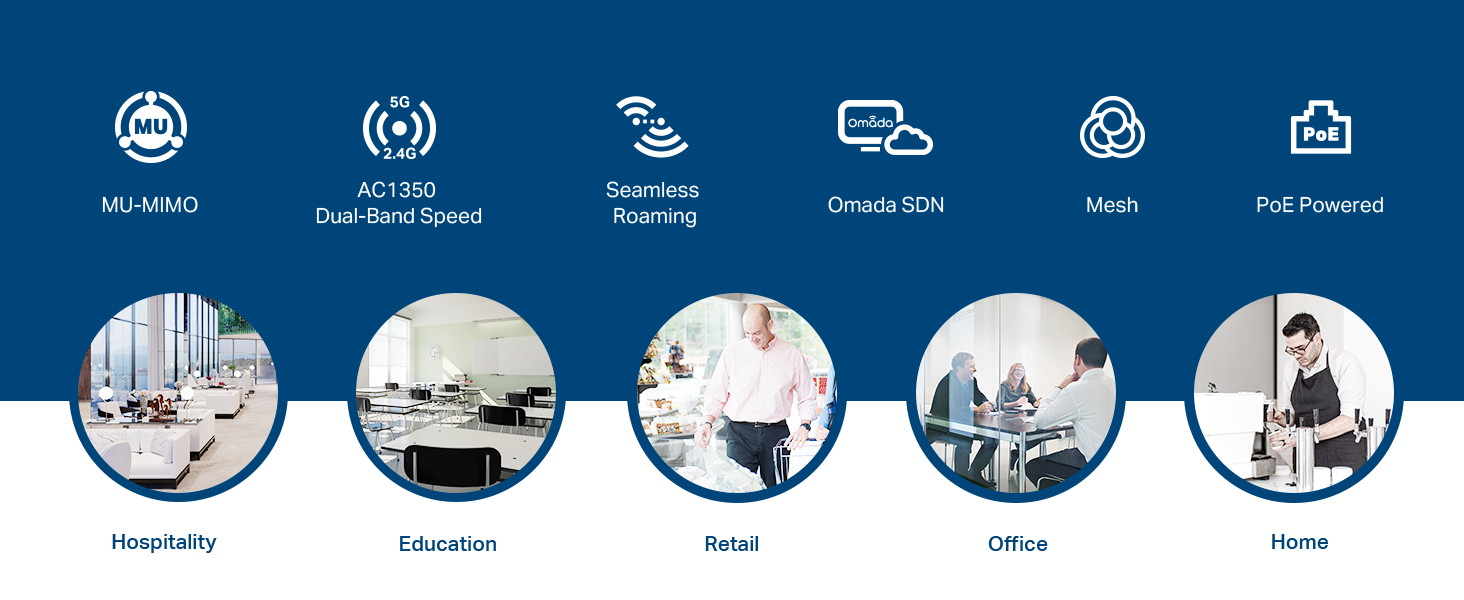
The TP-Link EAP225 is a business-grade AC1350 dual-band wireless access point featuring flexible PoE power options, MU-MIMO for multi-device efficiency, and built-in mesh support for scalable coverage. Integrated with Omada SDN cloud management and seamless roaming protocols, it ensures reliable, high-speed WiFi tailored for professional environments and smart homes alike.


| ASIN | B0781YXFBT |
| Antenna Location | Business |
| Best Sellers Rank | #13 in Computer Networking Wireless Access Points |
| Brand | TP-Link |
| Built-In Media | AC1350 Wireless MU-MIMO Gigabit Ceiling Mount Access Point EAP225 Power Adapter Mounting Kits Installation Guide |
| Color | PVC |
| Compatible Devices | Personal Computer |
| Connectivity Protocol | ethernet, wi-fi |
| Connectivity Technology | Wi-Fi |
| Control Method | App |
| Controller Type | Switch |
| Coverage | Indoor |
| Customer Reviews | 4.6 out of 5 stars 3,318 Reviews |
| Data Transfer Rate | 1350 megabits_per_second |
| EU Spare Part Availability Duration | 5 years |
| Frequency | 2.4 GHz |
| Frequency Band Class | Dual-Band |
| Global Trade Identification Number | 00845973093006 |
| Item Dimensions L x W x H | 8.09"L x 7.15"W x 1.47"H |
| Item Type Name | access point |
| Item Weight | 1.1 pounds |
| LAN Port Bandwidth | 1350 megabits per second |
| Manufacturer | TP-Link |
| Maximum Upstream Data Transfer Rate | 867 megabits_per_second |
| Mfr Part Number | EAP225 V3 |
| Model Name | EAP225 |
| Model Number | EAP225 |
| Number of Items | 1 |
| Number of Ports | 1 |
| Operating System | Linux |
| Other Special Features of the Product | Access Point Mode |
| RAM Memory Installed | 128 MB |
| Router Network Type | hybrid |
| Security Protocol | wpa2-enterprise, wpa-enterprise |
| Special Feature | Access Point Mode |
| UPC | 840460602310 845973093006 |
| Voltage | 12 volts_of_direct_current |
| Warranty Description | Limited Life Time Warranty |
| Wi-Fi Generation | Wi-Fi 5 |
| Wireless Communication Standard | 802.11ac |
| Wireless Compability | 802.11ac |
V**G
Great wifi access point
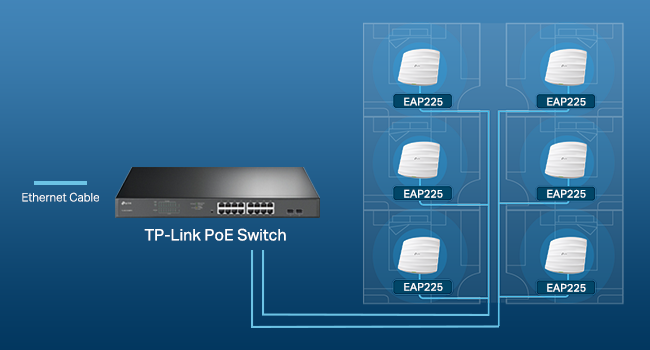
I bought one of these for the opposite end of my ranch-style house, since my router's wifi was weak at that distance. I like that it's POE, so I only had to run a CAT5e cable to it and hook it to my POE switch (although it comes with its own POE power injector which is a nice bonus). The setup was fairly straight forward using the app to get it set up initially, and later using the built-in web admin page through a browser for additional changes. It puts out a decent signal, but I was a bit disappointed in that it didn't quite make it from its location to my office, which is on the same level, but about 50 feet away with about 3 hollow (stud/drywall) walls between. My office seems to be somewhat of a dead zone in the house due to its layout, so I ended up buying another for near my office, creating a triangle around the perimeter of the house with my router and the two APs. When you're within 20-30 feet of the AP and no walls, it works very well and signal is quite strong. In my tests, it provided full throughput for my internet service, just make sure you connect it to a gigabit router and/or POE switch or it will only operate at the speed of the slowest link. My existing POE switch was only 100 mbps (for security cameras), so the switch was limited to that throughput, so I added a gigabit POE switch and connected the APs to that instead and they now show full throughput on internet speed tests. One feature I really liked was the ability to add additional SSIDs. During initial setup it asks for your 2.4GHz and 5GHz passwords, but I also have a 2.4GHz and 5GHz guest networks on my router. After the initial setup, I went into the browser interface and found a small "add" (+) button near the list of SSIDs and I was able to add the guest network SSIDs for each frequency. I was also able to select them as "Guest" networks in the AP configuration pages. I duplicated the SSIDs from my router and there doesn't seem to be any conflicts. Wirelress devices just seem to pick up their connection from the closest AP or the router depending on where they are in the house, which is how I hoped it would work. For installation, the mounting plate attaches to the ceiling, then you "twist" the device into to three "tabs" until it lock in place. This part was a bit tricky as the tabs seemed tight. Getting it to twist into the tabs is difficult to align as you place the AP over the bracket, and I really had to push the AP up and rotate it hard to get it to snap into the bracket. The "snapping" process on one of them took a lot of force and I thought I broke it when it finally locked in, but it was fine. It has a tab you can insert a paper clip into to release it from the bracket for removal. I think the mounting plate design could use a bit of a rework given my experience, but it's certainly not a reason to pass this by. Another inconvenience was the fact that updating the firmware causes all your settings to be lost. This happened with both devices. I hope future updates don't require a full reconfiguration of the device each time. I'm looking forward to great wifi throughout my house now. So far, the devices that were previously located in a "dead" or "weak" spot (for example, streaming boxes that could only able to get 1-3 mbps) now get 90+ mbps so it definitely solved those issues. Just be aware that depending on the size and layout of your home, you may need more than one. I didn't want this to be visible in the center of my living room ceiling (which is the center of my home), so I had to install them in hallways which are more on the perimeter of the home, thus needing more than one to get full coverage. For the price, this was an excellent choice for our home and I highly recommend it.
P**N
Great access point for home users!
Shortly after setting up our WiFi in our new home, it became obvious that having our WiFi router in the basement where the cable modem is located wasn't going to cut it. The cement walls absorbed much of the WiFi signal and, even in our small home with a 40'x28' footprint, we had dead spots. I needed to move our WiFi access to the attic. I bought two TP-Link Omada access points, this Omada AC1350 dual-band router for my wife's and my phones, tablets, and laptops, plus an Omada N300 unit to support our Internet of Things (IoT) and guest WiFi users. Both units are powered by Power-over-Ethernet adapters in the basement connected to a new, Mikrotik hEX small-business router. Using a separate router allows me to segregate our guest users and IoT devices (smart home stuff, Kindles, Alexa speakers, and so on) onto their own, less-secure network and put our private computing resources where our financial and personal data resides. (Note: Our streaming devices, Roku TVs and the like, are connected to the same logical network as our IoT stuff, but have wired connections.) Both Omada access points have been champs. Located in our attic, they were easy to set up as stand-alone access points using TP-Link's Android app, and both provide a strong signal everywhere in our 3-level (basement, main level, and attic) home with an 1100 square foot footprint that extends into our front and back yard. We no longer have dead zones. (Yay!) I only ran into one problem with the Omada AC1350. It was a funny, if embarrassing, problem! The Omada N300 and AC1350 access points are slightly different sizes but have very similar-looking wall/ceiling mounting plates. I spent an unreasonable amount of time trying to figure out why the AC1350 wasn't connecting to its mounting plate before it dawned on me I was trying to hang it on the N300's base! Since then, everything has worked flawlessly, and I can recommend either solution. Pros for the TP-Link Omada AC1350 Access point: * Low cost. * Strong signal. * Plenty of bandwidth for most home users. Can easily support one to two dozen devices. * Very easy to configure as a stand-alone unit with TP-Link's Android app. (The IoS app is probably about the same.) * Comes with a Power-over-Ethernet injector. * Supports mesh WiFi if you add additional access points and a mesh controller. * Reasonably unobtrusive, about twice the size of a smoke detector. * The power indicator light can be turned off in software. Cons: * Great for home use, but probably underpowered for a business environment. I'd move up to an AC1750 access point for office use.
C**C
Pretty Much As Perfect As It Gets!!
First of all, let's get this out of the way. There's a review that states: "You can’t program this device (create and ssid and password protect your WiFi) without downloading their app that logs all the sites you visit TP Link shares this information with their 'partners' per their privacy policy..." Let me explain what I did and let you be the judge. I installed one. (I ordered two and they're both installed now.) Then I discovered its IP address using Advanced IP Scanner. (I also could have used IPScan or looked at a status page on my router.) At no time did I use a mobile device for anything, let alone download an app. From there, I its (really GOOD) GUI interface, turned off its DHCP and set the IP address I wanted it to be, using Firefox (I could also have used Chrome, Opera, or K-Meleon, all of which I have installed. I then went back in and set everything else the way I wanted it. If the reviewer was talking about the Omada software (which I don't use), he should have stated that. I hope this will allow you to make it past that review and read some "real" reviews. There are no cons that I can think of except those dictated by the limits on WiFi imposed by the FCC. The range is not miraculous, but it's VERY good. Really nice 360 degree coverage!! (When mounted on the ceiling, anyway!) It's extremely competent and secure, with lots of settings. Guest networks with lots of settings. Pretty much each and every setting can be set for each band (2.14 or 5GHz) and for the guest networks - separately. I have a 10 foot ceiling throughout, with ceiling tiles. I can't tell you how pleased I was that long, thin screws, "fender" washers and wingnuts were included just for that!! I can almost say it's a tool less installation, but you do have to cut a hole in the ceiling tile. I used my Swiss Army Knife. They look really nice. The power LED is very bright and visible and can be turned on or off in the settings, too. Two of them have been running flawlessly for almost two months now. It's a 3000 square foot building and it's notorious for "eating" RF. It's cider block and it even has some cinder block wall on the inside. The best cordless phones made can barely make it from one end to the other and die almost as soon as one walks outside. These two EAP's cover it completely and even reach outside! There is nowhere I can go where the signal strength isn't at least "Good". In most places, it's "Excellent". Now there's WiFi outside, too, as long as one doesn't stray too far. One is powered by the PoE adapter that came with it, and the other is powered by a PoE gigabit switch. They work great either way. And they're as fast as gigabit Ethernet, anyway! I can't think of anything I've ordered from Amazon that I like more than these things! I'd be happy if I'd spent twice the money for them; just to avoid the "junk" out there! I'm starting to have all kinds of faith in TP-Link - especially when it comes to WiFi!!
D**N
Good, inexpensive wall/ceiling mount POE AP
I have cars that use WiFi when they are home but which, for several odd reasons, can't use the home WiFi network so I wanted a separate, standalone access point to put in the garage. The requirements were that the AP be ceiling mountable, powered by POE, have a gigabit uplink (my POE switch won't do 100 Mbps), have an RF output power control (it only needs to cover the garage) and otherwise be as cheap as possible. The EAP225 was the best match I could find. The AP is easily configured standalone with a web browser once you determine its address from the DHCP server. I've had mine for 7 months now and it has worked continuously without reboots or (intentional) power cycles. I've fiddled the tx power control down to the minimum that allows the cars to reliably connect from their parking spots with minimal interference to the house network (by default the AP is very loud). It works well. I do have a couple of minor issues with the device, however. The first of these is that, if you do a firmware update, at no point does it tell you that this will wipe the AP configuration back to the factory default. This needn't be a major issue since you can fix the device's address with your DHCP server, and upload a pre-update configuration file that can be downloaded back post-update via the web browser interface, but you need to know to do this and nothing tells you. The second issue is the mounting plate, which I wish was sturdier and had more holes. If you are lucky enough to live in a house that has been prewired for access points these are usually supplied as 1-gang wall boxes in the ceiling with the cables inside, covered up by blank wall plates when not in use. When you install the AP you unscrew the wall plate and attach the AP's mount to the wall box in its place using the same screw holes. This is more secure than mounting to drywall and doesn't leave holes in the ceiling beyond the box that is already there. All the AP's I've used have hence had mounting plates with holes spaced to match a standard wall box (along with holes for alternative mounting) except for this one. I considered just drilling holes in the right spot in the mount plate but decided it might be too flimsy to survive that, so I ended up (very) roughly cutting and drilling a piece of acyrlic I had to screw to the wall box and then screwing the AP mount to the acyrlic using its three existing holes. Other than those two annoyances, however, this AP has been good for not a lot of money.
R**R
Does what I need it to do, roaming seems to work with my att fiber router (BGW320-500)
I'm renting a townhouse with cat6 ran to the ceiling on all 3 floors for in ceiling access points. The router that ATT provided with their fiber service (a BGW320-500) is fairly strong and can make it's way up from the basement closet (where the fiber connection is) all the way to the top floor to the point where it is "usable" but speed definitely drops down to sub 100mbps, and when several devices are using data on the top floor, all the dropped packets can slow the entire network down. Enter this device, which I bought as a trial to use the built in cat6 cable, and possibly buy another 1 or 2 with an OC200 controller (or run the controller software on hardware I already have running) and just disable the BGW320-500's antenna all together. The BGW320-500 doesn't put out PoE, so I needed the power adapter, but it works fine (although its a bit messy in my networking closet and would like to buy a PoE switch eventually). I did fry my network cable tester by having the signal emitter on the ceiling end to identify the right cable in the network cabinet, and then connecting the power injector on to the cabinet end, sending PoE *into* the signal emitter. By the time I realized what I did, it was non-functional and had burnt electronics smell. If you need a cable tester to find the correct cable, be sure to remove the device before connecting to PoE. After connecting the access point to the PoE live cable, it turned right on. It took maybe 30 seconds to mount into the drywall ceiling with the adapter plate. It comes with drywall anchors but the device can't weigh more than a couple of pounds, and 3 screws seems to hold it fine without any additional weight hanging from it. When first connecting it, it was able to hang from just the cat6 cable without any real amount of stress, so if by some chance we have an earthquake and it falls from the screws, it still shouldn't fall to the ground. After that, it's as simple as finding the IP in your router's client table, going to the web access panel, and setting up the SSID/Password (I used the same as my home network). There's even a feature buried in the configuration that you can disable the status LED, which I did, considering it's mounted right outside of my bedroom door. After the SSID/Password were set up, it worked flawlessly. You can see which clients are connected directly to it. The ATT router config menu even shows it as an "access point" which I believe helps it recognize the roaming 802.11 standards, and they somehow control the handoff amongst the two devices with no extra configuration needed, because several devices have switched over to the access point without being power cycled. My phone gets upwards of 280-300 mbps on the top floor now, which was only ~100mbps before, so it's definitely a massive improvement. No more loading delays where I have to drop wifi and connect to 5g to keep moving, everything seems to have "full service" level speed/connection. It actually works so well that my plans to buy another one or two with a PoE switch and a dedicated OC200 controller have been sidelined until I have some more "play money" spending cash, because I just simply don't need them anymore. It seems to cover the largest dead spot in the house, and now I get reliable connection across all 3 floors without needing to spend a couple hundred bucks. Finishing out the full 3 AP setup with a PoE switch is just a "nice to have" luxury at this point.
S**M
Small-business-grade Mesh Networking
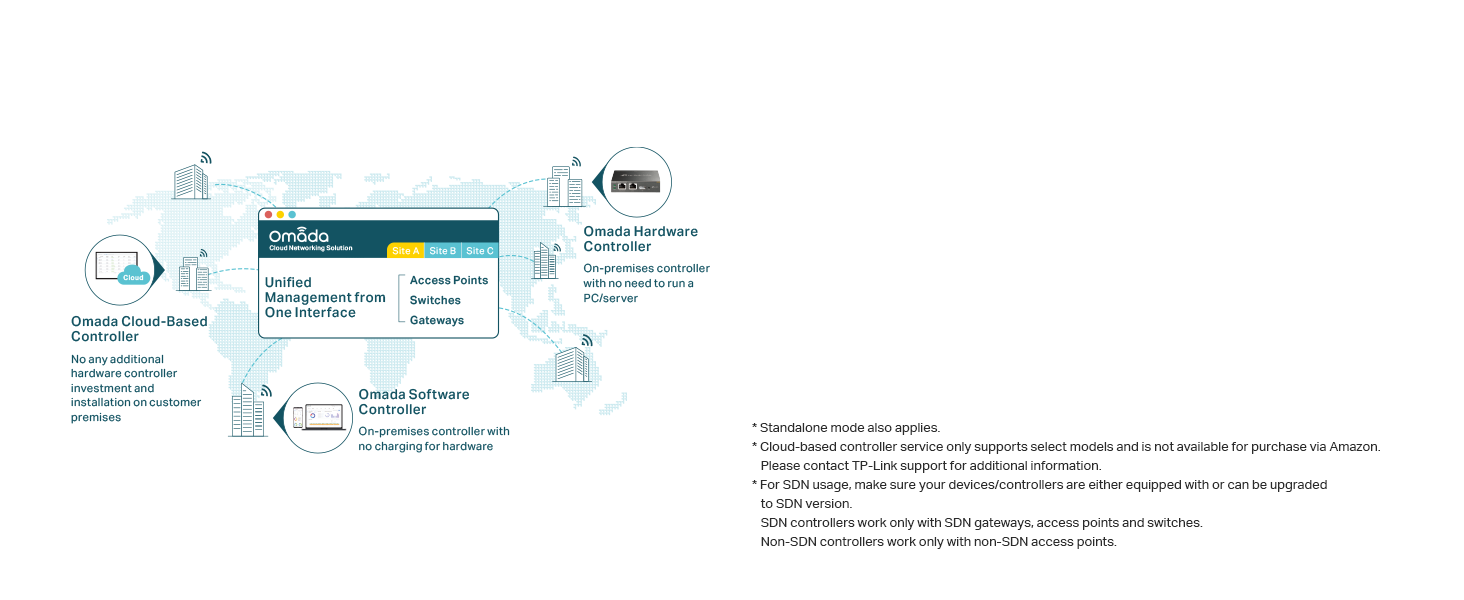
I got my first AC1350/EAP225 way back in 2018 during a Black Friday sale. I got a second one this week to see how well the mesh networking feature works. For the price, I am really impressed. Before buying, I was concerned because one other reviewer said his mesh network collapsed when he powered down the PC that hosted the controller software, but that hasn't been a problem for me so far. I shut my home PC down over night, and noted that both APs were up and serving traffic just fine when I woke up this morning (before turning on my PC to run the controller software again). My second AP isn't connected to anything other than a garage wall outlet, so I know it's working without the controller running when I'm on the other end of my property surfing YouTube on a laptop. When I fired up my PC and the controller software this morning, I noted half a dozen clients from my in-laws RV in the driveway were already connected and merrily surfing away while my PC remained off. Speaking of the controller software, it's pretty nice. Some of the English is a little broken, which I find funny, but otherwise, the software is really high quality, especially for being free. It has lots of features like channel strength scanning, showing a map of clients, event log, available bandwidth, who's using which bands, signal strength, error rate, throughput, and a lot of other stuff. It's pretty fancy. It looks like the controller software is built with Java and runs some sort of Java servlet container. You access the UI via browser. I noted that the software uses a self contained Mongo database server. I elected to install the software to my "Program Files" folder, so I had to adjust some NTFS permissions to allow Mongo db write access and make it work correctly, but it otherwise doesn't need to run as Administrator. If you have no idea what I'm talking about here, this EAP setup may not be for you, but if you're an IT person like me, it's great. I'm a software engineer that didn't even know what 'mesh networking' was exactly, last week, and I found it pretty easy to learn and implement. The 'Omada' software is available and regularly updated on the TP-Link website, and I had to download new firmware for my APs right off the bat, too. Once the software is running though, it's pretty simple to provision the access points. Just make sure you know what you're doing with WPA2, passwords, etc. to keep your network to yourself, of course. The package doesn't have any of the BS bloat that ships with home version mesh network packages like 'Antivirus' junk and 'Parental Controls', that I can tell. Just pure, professional, wireless networking. It does have things like 'Guest Network', and some other bells and whistles geared toward small businesses. This package feels like it was made for IT people and an office, and that's good.
O**L
It is quite amazing how much you get for the money with this EAP 225 v3
Update June, 2022: still perfect. Update 8-19-2019 : Still going strong and no complaints! I only have one of these and I am using it in a home environment. I really should have just logged in to it and configured it by ip but I am a bit of a nerd so I run the free ormada controller software on a VM. I saw a few reviews talking bad about the controller software but I haven't seen any stability issues yet on version 2.6.0 but then again, I am just running one EAP in my home at this point. I previously ran a TP-Link TL-WA901ND which is a 3x3 MIMO 802.11n WAP. I was extremely happy with it. It had amazing coverage, PoE capability and the speed was great for a 2.4Ghz single band WAP. I bumped our internet speed from 100 Mbps to 300 Mbps and all of a sudden, the 100Mbps Ethernet port on the WAP was a bit of a bottleneck (As well as the real world speeds of 802.11n). Update: I bought a couple cheap 8 port managed switches to try out the VLAN tagging on this thing and boy is it a nice feature. I now have a guest network with a captive portal that tags to a guest network VLAN which I restricted to accessing only the WAN and the VM running the TP-Link controller software so the captive portal displays properly. I love this EAP. I really love that with the controller software, if I ever need to add another it should be a very painless and seamless process. I picked this particular model to replace the WAP over higher performing models due to it's support for passive PoE and that it even included the injector. The low price helped too! I wanted one of their EAP models due to the extended features like VLAN support on a per-SSID basis and the captive portal. I always wanted a guest network that was truly segregated from my normal subnet. So I have been running it only for about a day so far and am extremely happy. Yes, the range is a little less than the powerhouse TL-WA901ND that it replaced but it still adequately covers my little 1200 sgft house and the back yard. If I need to add another, the controller software would make the integration incredibly easy. The speeds have been great so far with an average of 8 devices concurrently on the AP. IT supports MU-MIMO but I would be surprised if even one of the wireless devices in my house did so that is useless. It does also support beamforming, band steering and airtime fairness which is quite impressive considering the price. Sure enough, once I enabled band steering it punted my wife's ipad, son's iPhone, our Roku and my laptop right up tot he 5GHZ band. I created a second SSID in seconds on the 2.4 GHZ band, assigned it upload and download caps and created a quick captive portal in maybe 3 minutes tops. It also will support vouchers including the ability to print them out for you to cut up and distribute. The statistics you can pull up with the controller software are impressive as well. Once I get the two managed switches in that I ordered I will be able to VLAN my guest network onto a separate subnet with internet access only. I am just blown away with the things this EAP can do for the price. This along with the controller software would be perfect for a small to medium business.
M**N
Fast and Easy VLAN capable Multi-Network System, No Need For Controller
I'm a bit of a nerd and I run a home server, so I wanted to split my network up into different subnets using VLANs. My only holdup was wifi devices since I couldn't risk bricking one of my access points using alternate firmware. These are out-of-the-box capable of setting VLANs to separate wifi networks, which is a commodity (aside from using open source firmware). You can look at Ubiquiti, but they are more costly than these. At $60 a pop for the EAP225 this was an easy buy and I have had almost no issues setting it all up. If you have a hardware controller with them, then its even easier. The hardest part was getting the controller software running in a VM, the dependencies took a bit to get right, but after that was up and running. I could have used the phone app to do it all, but I wanted the extra features you only get with the controller. If you have a raspberry pi or NAS you could forego the controller hardware and still get the features, which is a huge plus, usually big names handcuff you to their hardware to make a few extra bucks, but not in this case! The features you get are beam forming (better range and speed) and fast roaming (faster switching between access points in a mesh). These will work just fine without a controller! If you are going cheap you don't have to get it, you can always get it later, just use the phone app to set up the access points. These are all POE devices, so it comes with an injector. I haven't done this, but I read that if you set it up in a mesh, you can actually use the POE LAN side to extend to another wired device or switch. So this works as a wireless bridge as well. The only part that takes some getting used to is that when you lose your DHCP server (usually your router), the wifi networks disappear entirely. I thought that was very odd and something was wrong, but when it comes back they come back with it. That could be an artifact of how I have the mesh set up, but it is still odd. That really doesn't happen often unless you have a hardware failure, it was mostly when I was messing with VLANs and screwing things up. They also have very good range, better than my Asus RT-AC3200 APs that they replaced.
J**C
Fast & easy
I don't know the brand TP-LINK very well but decided to try a couple of these. VERY impressed. Easy to set-up/update/config and excellent throughput and range. So far zero complaints. Will buy again.
V**R
Best WiFi AP
I was struggling to find a better access point which would give max speed and best coverage. I now have zero issues with WiFi. It’s as good as wired network. Go for it without doubt.
M**D
ممتاز
التغطية ممتازة جدا سعره رخيص جدا مقارنتا بالشركات الثانية جودة التصنيع لابأس بها التثبيت للنوع ذا بس للسقف بتواجه صعوبه لو بتثبته بالجدار الجانبي
S**Y
Excellent
I already had two of these and got this one to replace the Telstra modem Wi-Fi as I replaced the modem with a TP-link router (Er605) but they don’t have Wi-Fi. I connected this unit to a TP-link PoE switch (TL-SG2008P) to provide power to the unit. My other two units are using the PoE injectors that are included. I have my network managed using the Tp-link Omada controller and it was seamless, was able to easy firmware updates and configure SSID’s etc simply. I would recommend the units as they seem extremely stable and give very good coverage.
S**T
The product was good as described
Good procuct
Trustpilot
5 days ago
2 weeks ago