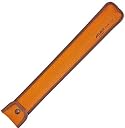
Desertcart purchases this item on your behalf and handles shipping, customs, and support to India.
🎶 Unlock your inner musician with the Aulos C-21 — where beginner ease meets pro-quality sound!
The Aulos C-21 Pipit Series Classic Fife is a beginner-focused, two-piece woodwind instrument crafted from durable ABS resin. Designed in Japan, it offers a bright, clear tone in the key of C, with easy-to-play embouchure holes and a lightweight, portable build. Ideal for students and new musicians, it comes complete with a protective case and fingering chart to support confident learning and long-lasting use.
| ASIN | B001H2G3V0 |
| Best Sellers Rank | 42,731 in Musical Instruments & DJ ( See Top 100 in Musical Instruments & DJ ) 10 in Fifes |
| Brand | Aulos |
| Brand Name | Aulos |
| Colour | White,Brown |
| Country of Origin | Japan |
| Customer Reviews | 4.2 out of 5 stars 20 Reviews |
| Finish Type | Polished |
| Global Trade Identification Number | 04582202781001 |
| Included Components | Case |
| Instrument Key | C |
| Instrument key | C |
| Item Dimensions | 33.7 x 6 x 6 centimetres |
| Item Weight | 0.21 Grams |
| Item weight | 0.21 Grams |
| Manufacturer | Aulos |
| Manufacturer Part Number | 1701L |
| Material | Resin |
| Material Type | Resin |
| Model Name | Pipit |
| Model Number | C-21 |
| Sound Profile | Clear, responsive and even |
| Style | Traditional |
| Unit Count | 1 Count |
D**D
Great fife
Great fife just need to learn now how to play it
S**S
Wonderful little musical instrument
Beautiful rich sound
K**R
No
No comment
M**C
A Quality 8 Hole Fife
Similar in design (but not a clone) to the Yamaha 8 hole fife but easier to blow and play in tune. Has a double-hole F in the lower octave to permit a fairly accurate F# (something the Yamaha fife lacks). The embouchure hole is rounder and smaller than the Yamaha one and is shaped more like a concert piccolo embouchure. The Yamaha embouchure has a more rectangular shape, nearer to the concert flute shape, but is more difficult to get a sound from. The Aulos is a quality instrument capable of a good tone and an accurate scale. An ideal starter instrument for those who want try out a (keyless) flute without spending big bucks for a keyed concert flute at $600+... Note: Not to be confused with the 6 hole military fife as played in the USA.
L**O
Aulos C21 Flauto Traverso FIFE Plastica
Si tratta di un flauto traverso in plastica Soprano.Le prestazioni sono molto superiori ai classico Flauto Dolce Scolastico,in quanto il suono viene prodotto dall'esecutore e non da un fischietto.Puo' suonare anche a basso volume.La qualita' e' ottima,puo' dare grandi soddisfazioni,ma richiede impegno.Molto robusto.E' il mio strumento preferito.
S**9
Nice instrument. The timbre is not a nice as ...
Nice instrument. The timbre is not a nice as the wooden one I own, but I can take this in my backpack without fear of it being damaged.
N**B
Excellent beginner instrument
Perfect, exactly what I needed. My daughter loves it
J**K
Prima Querpfeife aus ABS zum günstigen Preis
Die Aulos C-21 Querpfeife, auf manchen Märkten auch „Pipit“ genannt, ist ein preisgünstiges Instrument mit hochwertiger Verarbeitung (Made in Japan), gutem Klang und leichter Ansprache. Das Instrument ist aus elfenbeinfarbenem ABS (einem hochwertigen Kunststoff) gefertigt und wird in einem braunen, genähten Kunstlederetui mit Druckknopf geliefert. Es handelt sich um eine zweiteilige, klappenlose Querflöte in C, die, wie die bekannte Sopranblockflöte, eine Oktave höher klingt als notiert. Da auch der Tonumfang der einer Blockflöte entspricht, kann deren Literatur gespielt werden. Die Griffweise weist eine gewisse Ähnlichkeit mit der deutschen Blockflöte auf, allerdings wird in die Oktave überblasen; das Daumenloch wird nur für das C bzw. C# geöffnet- insofern eine gute Vorübung für die Konzert- bzw. Böhmflöte, wo die große Daumenklappe die gleiche Funktion erfüllt. Überhaupt dürfte die C-21 durch die geringe Größe und das geringe Gewicht gerade auch für jüngere Menschen geeignet sein, die das Spiel der Querflöte erlernen sollen und hoffentlich auch wollen. Die C-21 hat ein Doppelloch für das F bzw F#, Gabelgriffe werden nicht benötigt. Eine chromatische Grifftabelle liegt bei. Anders als ihr Urahn, die schwarze Aulos No. 101 (Bilder: MItte) aus den 80ern (heute ein gesuchtes Sammlerobjekt) hat die C-21 keine Doppellöcher für A# und D#, hier müssen die entsprechenden Fingerlöcher halb bedeckt werden. Die C-21 hat eine konische Bohrung (d.h. sie verjüngt sich zum offenen Ende hin) und spricht sehr leicht an und erzeugt einen vollen, angenehmen Ton. Da das Instrument in C gestimmt ist, ist auch das Zusammenspiel mit anderen C-Instrumenten kein Problem- zumal sich die zweiteilige Flöte in gewissen Grenzen feinstimmen lässt. Die Aulos C-21 steht in direkter Konkurrenz zur ähnlich konzipierten Yamaha YRF-21, die etwas preisgünstiger ist und insgesamt etwas zierlicher und eleganter wirkt, sowie zur so genannten Marschflöte, etwa der Sandner Sopran-Zauberflöte aus Metall (Bilder: oben). Wer vorhat, in einem Musikzug zu spielen, sollte eventuell mit der Sandner-Flöte anfangen, da sie dort den Standard darstellt, wenngleich sie erheblich teurer ist. Nette Details sind das farblich leicht abgesetzte Mundloch sowie die Markierung auf der Unterseite für die korrekte Ausrichtung von Ober- und Unterteil der Querpfeife. Ebenso gefällt das braune Kunstlederetui sowie die leichte Pflege- das Instrument kann mit Spüliwasser gereinigt werden und muss auch nicht eingespielt werden. Das Auseinandernehmen ist ohne Kraftaufwand möglich, ein Kork ist nicht vorhanden. Eine klare Kaufempfehlung nicht nur für Anfänger - auch als zusätzliches Instrument für draußen oder für unterwegs eine lohnende Anschaffung.
M**N
Da avere; ottimi suoni bassi; peccato il foro nudo.
Avevo già altri pifferi traversi. Nella foto, il primo è un vecchio Aulos (modello 101), il terzo è lo Aulos C·21 che ho acquistato, il secondo e il quarto sono di altre marche. I primi tre sono contento di averli, mentre il quarto non lo ricomprerei: esso è uno strumento meramente didattico, e neanche ottimo come tale. Per suonare è inutile: produce a malapena (stentatamente) una ottava e mezzo, con timbro assai povero. Gli altri tre pifferi producono più di due ottave: da un ⁵Do a un ⁷Mi. I timbri dei due Aulos sono assai diversi tra loro: "trillante" quello del 101, più "da corno" quello del C·21. Il C·21 produce facilmente le note più basse, il 101 le più alte. Il 101 è comodissimo tra le mani, il C·21 pure, ma un po’ meno. Un grosso neo del C·21 è la mancanza di una sagomatura per il labbro inferiore. Il foro sonante si sposta troppo facilmente da una giusta posizione allineata con la bocca. Un grosso vantaggio dei due Aulos è il doppio foro che permette di produrre i Fa·d delle due ottave senza ricorrere a due scomode e distinte diteggiature a forcella. Nota importante riguardo alla diteggiatura dei due Aulos (e degli altri due pifferi): su scala diatonica, dal ⁵Do basale al ⁷Do, essa è tutta lineare, non è affatto "tedesca" come quella dei flauti dolci didattici (che è lineare per la mano destra e barocca per la sinistra, un’ accoppiata che reputo diseducativa). Per via della suddetta diteggiatura lineare, e grazie al foro doppio dei Fa·d, sui due Aulos si possono produrre due scale maggiori sovrapposte, su due ottave (⁵Do--⁶Si, o ⁵Re--⁷Do·d), senza nessuna diteggiatura a forcella. La seonda scala è quella tipica dei pifferi dritti alla irlandese. Per chi non avesse mai provato un piffero traverso: occorre esercizio per trarne bei suoni, e occorre guida per imparare a farlo: un libro apposito, o dei tutorials, o qualcuno che lo insegni, come nel mio caso (ho avuto un compagno di sport che era un flautista). A proposito di ciò, si tenga a mente che il web è pieno di "finti" esperti. Ricordo per esempio una persona che in un tutorial non riusciva a produrre da un Aulos 101 note di seconda ottava a basso volume, e diceva che ciò fosse normale. Invece NO, non lo è affatto: sia sul 101, sia sul C·21, si può arrivare fino al ⁷Re, o saltare, mettiamo, da ⁵Si a ⁶Si, a volume bassissimo, "sussurrando" note. Il C·21 non mi pare ben adatto a principianti assoluti, per via del suo foro sonante nudo e della sua minor propensione, rispetto al 101, a emettere note alte. È però ottimo per gli altri, ed è ottimo il suo timbro morbido e "pieno", specie nelle note più basse. Bottom line: sono contentissimo di avere un Aulos C·21, e ne comprerei subito un altro se ce ne fossero di altri colori o bicolori, con aspetto più moderno (ma ciò è un gusto personale). Inoltre, comprerei SUBITO un eventuale C·21 aggiornato, con un minimo di sagomatura per il labbro.
Trustpilot
2 months ago
3 weeks ago