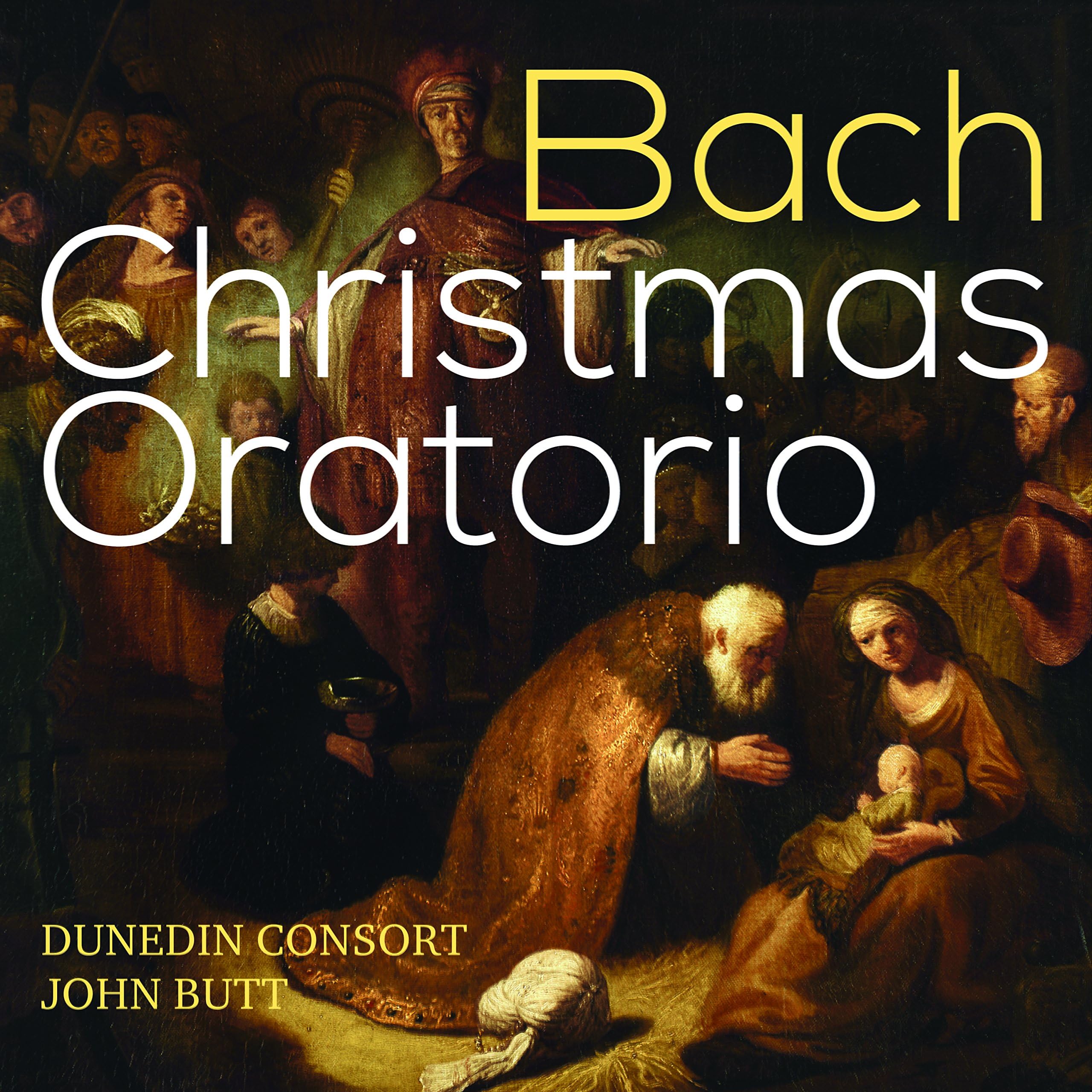
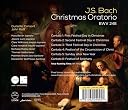
J.S. Bach: Christmas Oratorio
Product ID: 59335100
Desertcart purchases this item on your behalf and handles shipping, customs, and support to India.
J.S. Bach: Christmas Oratorio
C**E
The sheer clarity of sound transfixes your very soul.
Superb rendering of a truly great work.
J**L
Joyous and uplifting Bach
John Butt and his team have definitely done it again! Listening to this performance, compared to other accounts by, say, Harnoncourt and Gardiner, is like comparing Handel's Messiah with the Brahms Requiem, such is the buoyancy and freshness here in Butt's rendition! The opening, with its timpani and trumpets, gets off to festive start and sets the tone for what follows. I was quite surprised at how effortlessly things seem to move along thanks to the infectious rhythms and pacing. There is none of the devotional stodge that gradually begins to weigh things down as I have found in some other Christmas Oratorio recordings.The 6 cantatas are shared between two teams. Cantatas 1, 3 and 6 feature Mary Bevan, Clare Wilkinson, Nicholas Mulroy and Matthew Brook, while Cantatas 2, 4 and 5 feature Joanne Lunn, Ciara Hendrick, Thoma Hobbs and Konstantin Wolff. My admiration for bass-baritone, Matthew Brooke, has grown with every recording and he is here his ever reliable self. His first cantata aria "Herr, o starker Konig" has a wonderfully forward momentum with some marvelous trumpet playing. Nicholas Mulroy's ardent and young-sounding tenor is no less of a pleasure. Thomas Hobbs also turns in some sensitive and involving singing, as in his aria "Frohe Hirten, eilt, ach eilet". Admittedly I found Joanne Lunn a little on the bright side but not enough to mar my enjoyment. Mary Bevan was new to me and I really enjoyed her soprano.Overall, I'd say this account is best described as buoyant and bright-sounding. I really don't agree with the lukewarm review given by the other reviewer. Regarding the acoustics, if I wanted something churchy and ambient I could always go to a performance in a church. To me the the whole advantage of being able to have it on CD is for home play. Admittedly the singers and instrumentalists are forward as per Butt's other Bach recordings, but that's the very thing I like about them, the fact that the musical lines are so audible and present. Regarding choice of singers, if you're going to dismiss them for being too English, then the same has to surely apply to other English or mixed nationality teams. For example. I've heard some scathing things said about Bernada Fink's German, lovely as her singing is, or Ian Bostridge's nasal German in some of Herreweghe's performances. For such infectious playing and singing as we get here, I'm more than prepared to overlook nationalities and/or accents, not that in my case I found these to even bother me. Performances are very much in keeping with the style of Butt's other Bach recordings, so those who are familiar with them will know what to expect here.Well done to Linn for this vivid and clear recording. Strangely, this set is presented in CD format only (no SACD as in previous releases). Its no matter since the sound is incredibly vivid. It comes as a deluxe hardcover booklet, slightly bigger than CD case size. why? Who knows. Record companies seem to relish releasing these as though they are something special. Personally,I find them quite irritating when trying to get the discs out. But this is such a wonderful release that small niggles are not enough grounds to complain! I don't think I've ever played (and enjoyed) any recording of the Christmas Oratorio as much as I have this one! Say no more.
H**E
Four Stars
Brilliant.
C**E
Under the spotlight
My first reaction to this recording was to delight in the amazing recorded sound the Linn engineers have achieved. They present a transparent aural holograph – we can hear where every performer is and what they are doing, not just across the soundstage but even from front to back, even though these discs are just CD's not SACD's (as Linn discs have been until now). Then common sense set in. This sound is artificial in every sense. There is nowhere in the church a listener could hear this much detail except from inside the performing ensemble, and from there you would get no idea of the overall balance.The recording, though seductive, is unreal and it is finally unkind to the performances, though it does allow John Butt to achieve one aim, which was, as we learn from his notes, is to play with the resource options Bach may have had available to him in Leipzig in 1734. So these are one-voice-per-part performances, but the team of singers changes (the "Oratorio" was a series of cantatas originally performed over a twelve-day period, so "shifts" of voices were a possibility) and is sometimes reinforced by ripienists, who we must suppose to be less experienced Bach pupils. We can hear all this very clearly, easily distinguishing the various voices even in the noisiest "choruses", and very aware of doubling when it occurs – much more clearly than we actually would in Greyfriars where the recording took place, let alone in the echoing spaces of the Thomanenkirche. From this perspective – that of understanding Bach's performance practice – the recording is very interesting. But what about the actual performances the discs enshrine?The best things, in my opinion, are those jubilant "choruses", particularly the first numbers of the 1st and the 3rd Cantatas, the one with silvery trumpets and the other with wonderfully braying horns, the whole group enjoying themselves and conveying enjoyment; that some singers are more exuberant than others, or that German accents are wayward scarcely matters. But in quieter, and above all in solo numbers, these things become important. We hear all too clearly that – for instance – the women are much more careful (in a bad sense) than the men; and that the men are very inclined to be histrionic. We hear that neither "alto" has enough power at the bottom of the stave – Bach demands long-held middle c's. We hear that all the singers except one – the German bass – have very approximate German accents, and worse still seem to give little attention to the sense of the words; the narrative sections, in particular, suffer from this, both tenors taking a singerly, tone-focused approach, as opposed to story-telling.All these are problems of individual performers, but they all come back to John Butt's basic stance of setting out a history-based performance framework and the letting his performers have their head. In a concert this can produce very exciting results – as I have witnessed – but in a recording, unless the team are very well-matched and have performed the programme a great deal, he risks producing what we have on this set: an interesting idea, too roughly delivered to bear repeated listening.So, a disappointment, certainly compared to the last Dunedin set, the "Christmas Magnificat", and definitely if compared to Sigiswald Kuijken's 2014 Christmas Oratorio on Challenge, also single-voice-per-part, not lacking energy, but much more even, both in the matching of voices, and in musical judgement.
J**A
Erfrischende Version
Dies ist eine neue, erfrischende Version des bekannten Stücks. Besonders gefallen mir die weiblichen Solisten. Nicht schlimm wenn man manchmal mekt, dass hier Engländer die deutschen Texte singen.
D**.
Five Stars
Sublime performance and recording.
Trustpilot
3 weeks ago
1 month ago