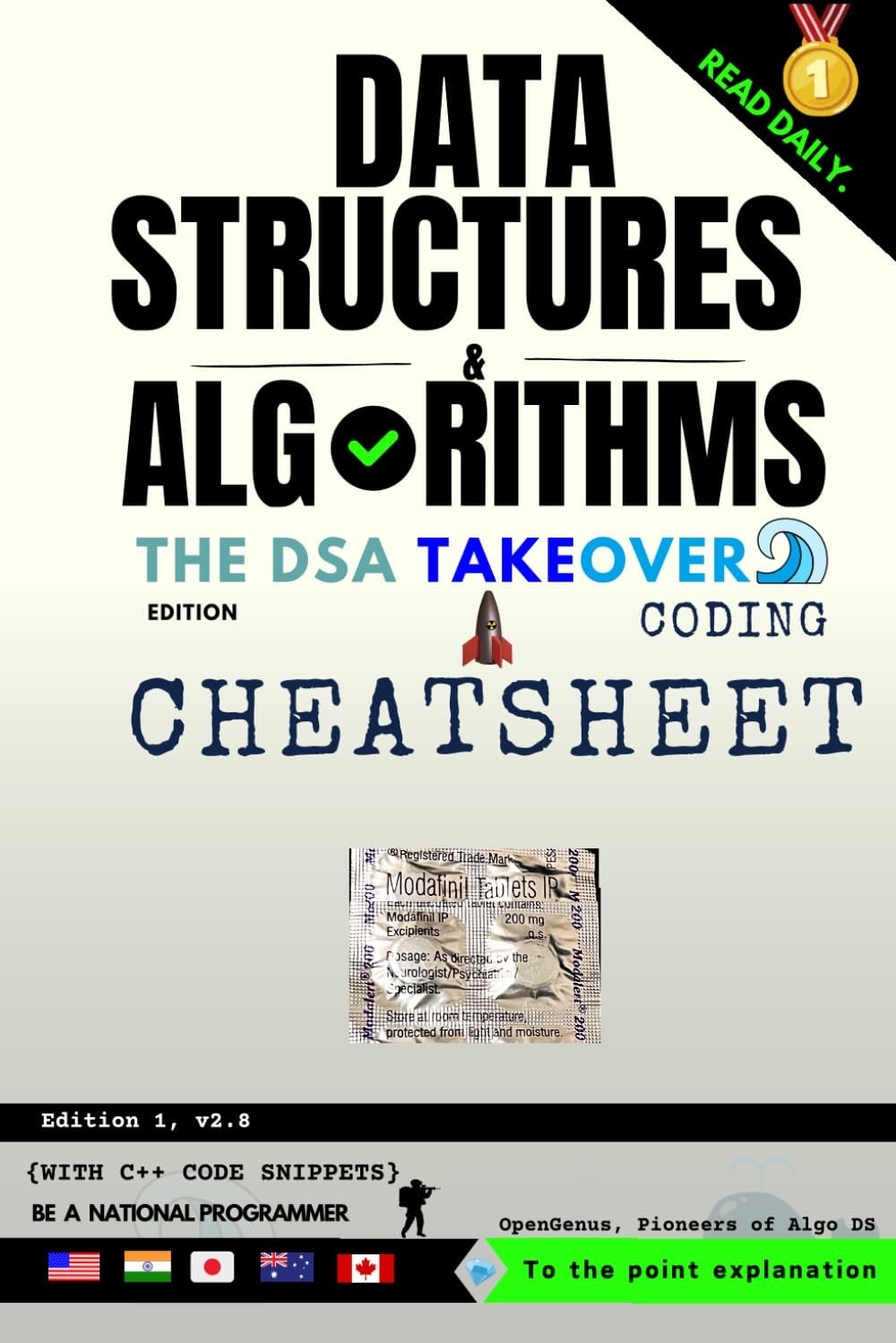
Data Structures and Algorithms: Coding Cheatsheet: The DSA Takeover Edition (Coding Interview Patterns)
Product ID: 666302552
Desertcart purchases this item on your behalf and handles shipping, customs, and support to India.
DSA Takeover : Work smart, master Algorithms quickly and secure your dream FAANGMULA job. Not just another Algorithms book. We give you the real intuitive practical problem-solving skill you lack . No AI will replace you if you have this skill. For theoretical knowledge and memorizing solutions, search algorithms and hash map were enough. We need you to be in your real greatest form. This book “ Data Structures and Algorithms: Coding Cheatsheet: The DSA Takeover Edition ” is the only book you need to master Data Structures and Algorithms coding problems for coding interviews. The plain truth is : This is a goldmine to help you take over the entire DSA knowledge. This book include: Chapters covering all core domains in Data Structures and Algorithms Each chapter is a CHEATSHEET . It includes time & space complexity table, to-the-point explanation and C++ code snippets . Each problem can be covered quickly in at most 4 minutes. Over 400 coding problems have been covered (with over 350 coding patterns ). With this, you will be able to crack any Coding Interview easily. After reading this book, you will: Master Data Structures and Algorithms. Clear interviews for full-time positions at high-tech companies (good enough for L3, L4, L5, L6 at Google). On going through this book, you do not need to solve 1000s of problems from Leetcode by spending over two years. Follow this book, practice the problems and ace every coding interview. Be wise . This book is for: Students and developers preparing for Coding Interviews. Developers who wanted to tune their Data Structures and Algorithms skills. Students who need a coding sheet to revise DSA topics quickly. Get started with this book and change the equation of your career. Book: Data Structures and Algorithms: Coding Cheatsheets: The DSA Takeover Edition Authors (2): Aditya Chatterjee, Ue Kiao About the authors : Aditya Chatterjee is an Independent Researcher, Technical Author and the Founding Member of OPENGENUS, a scientific community focused on Computing Technology. Ue Kiao is a Japanese Software Developer and has played key role in designing systems like TaoBao, AliPay and many more. She has completed her B. Sc in Mathematics and Computing Science at National Taiwan University and PhD at Tokyo Institute of Technology. She was a visiting scholar at Columbia University. Originally Published: 1st October 2024 (Edition 1.0) Updated on: 22 April 2026 (Edition 1, Version 2.8) Pages: 413 Publisher: © OpenGenus Table of contents : 1. How to use DSA Takeover? 2. CHEATSHEET: Search Algorithms 3. CHEATSHEET: Selection Algorithms 4. CHEATSHEET: Sorting Algorithms 5. CHEATSHEET: Basic calculations 6. CHEATSHEET: Arithmetic Operations (Complexity Analysis) 7. CHEATSHEET: Exponentiation Algorithms 8. CHEATSHEET: Recursion & Iterative algorithms 9. VISUALIZE: Basic Data Structures 10. CHEATSHEET: Array 11. CHEATSHEET: Stack 12. CHEATSHEET: Linked List 13. CHEATSHEET: Greedy Algorithms 14. CHEATSHEET: Dynamic Programming [DP] 15. CHEATSHEET: Permutation Algorithms 16. CHEATSHEET: Bitwise Algorithms 17. CHEATSHEET: String Algorithms 18. CHEATSHEET: Graph Algorithms 19. CHEATSHEET: Crazy Hard Problems 20. CONCLUDING NOTE Review: Leet code example book - Interesting book Review: Scam and Incorrect - Incorrect and Scam - kindle edition is only 26 (of 325) pages but costs a full $9.99 - "preview" only mentioned inline - also poor layout, looks like screenshots taken on a 1999 website.




| Best Sellers Rank | #1,052,592 in Books ( See Top 100 in Books ) #35 in Data Structure and Algorithms #242 in Computer Algorithms |
| Customer Reviews | 4.7 out of 5 stars 636 Reviews |
B**P
Leet code example book
Interesting book
G**G
Scam and Incorrect
Incorrect and Scam - kindle edition is only 26 (of 325) pages but costs a full $9.99 - "preview" only mentioned inline - also poor layout, looks like screenshots taken on a 1999 website.
R**S
DON'T BUY THE DIGITAL VERSION
I got this book on a recommendation, so I didn't read the product description. I don't think I should have to read the description to find out that the kindle version is a tiny fraction of the paperback. And since I flipped through more than 15% of its 26 pages, I don't have the option of a refund. It's only $10, but come on. Why not just have the whole book digital? Why sell this under the same listing if it's that different?
R**H
Really really bad
Just look at all the other books this author puts out. They are clearly just trying to take people's money. The cheatsheets are often wrong which defeats the whole point
A**.
Low quality print and full of mistakes
To be honest, this book just isn’t worth the money. The print quality is pretty poor, and there are mistakes that you really wouldn’t expect from a reliable resource. In just the first few pages, I came across two major errors: 1. The book claims that the space complexity of Linear Search is O(N), when it’s actually O(1). 2. It misrepresents the core concept of Binary Search, directing readers to search the left half of the array if the target is greater than the middle element, when it should clearly be the right half. These are mistakes that will likely get you laughed out of your technical interview. Ironically, the book’s own Binary Search code is implemented correctly, which only makes the written explanation look worse. Given these mistakes I didn't even bother with the rest of the book and I can’t help but question all the glowing five-star reviews. I’m not too bothered by the print quality, but for 31 euros, I at least expect accurate information. I’ll be returning this.
A**H
Helpful DSA Cheatsheet for Quick Revision
I found this cheatsheet very useful for revising Data Structures and Algorithms concepts quickly. The content is well-organized and easy to understand, making it convenient to review important topics before exams, interviews, or coding practice. It covers key concepts in a concise format without overwhelming the reader. As a student, I liked how it saved time and helped me refresh important DSA topics efficiently. Overall, it's a great resource for beginners as well as anyone looking for a quick revision guide.
C**R
A webpage as a book
The typesetting is awful, it's as if they printed a webpage into a book. There is no forward, or good narration on what they are trying to present - it's like someone's obsidian notebook was sent straight to the printers.
A**H
The Ultimate DSA Revision Companion: From Confusion to Clarity in Data Structures & Algorithms
I recently read “Data Structures and Algorithms: Coding Cheatsheet – The DSA Takeover Edition” and it turned out to be a very structured and practical guide for revising core DSA concepts quickly. What I really liked is how every chapter is presented as a cheatsheet — covering time & space complexity tables, key patterns, important algorithms, and C++ STL snippets in a concise way. It saves a lot of time compared to going through scattered resources. The sections that helped me the most are: -> Arrays & Two Pointer Technique -> Linked List (including slow and fast pointer approach) -> Graph Techniques (BFS, DFS, Topological Sort, Dijkstra, Bellman-Ford, Floyd Warshall) -> Dynamic Programming basics -> STL usage for competitive coding The graph patterns section especially gave me clarity on when to use BFS, when to use Dijkstra, and how to approach DAG problems with topological sorting. The STL explanations (like vector, set, map, priority_queue, lower_bound, etc.) are very helpful for coding interviews and competitive programming. This book is great for: -> Quick revision before interviews -> Building strong DSA fundamentals -> Understanding algorithm selection patterns -> Improving implementation speed in C++ Overall, a very compact yet powerful DSA revision guide. Definitely recommended for students and developers preparing for coding interviews.
A**A
Excellent Quick Revision Guide for Core DSA Concepts
I recently read DSA Coding Cheatsheet and found it extremely helpful for strengthening my fundamentals, especially in Linked Lists. The book explains concepts in a very concise and structured way, making it perfect for quick revision before interviews or coding practice. The Linked List section clearly explains the difference between arrays and linked lists in terms of memory allocation and access time. I particularly appreciated the explanation of Singly, Doubly, and Circular Linked Lists along with their time and space complexity comparisons. The Fast and Slow Pointer technique was explained in a simple manner, which helped me better understand how to detect cycles and find the middle of a linked list efficiently. The complexity tables and key coding patterns make it easy to remember when operations take O(1) and when they take O(N). Overall, this book is very useful for building clarity in DSA concepts and improving problem-solving confidence for technical interviews. Also it is a very good book for revision one day before placement assessment
Trustpilot
5 days ago
2 months ago