Desertcart purchases this item on your behalf and handles shipping, customs, and support to India.
🔋 Power your off-grid lifestyle without interruption!
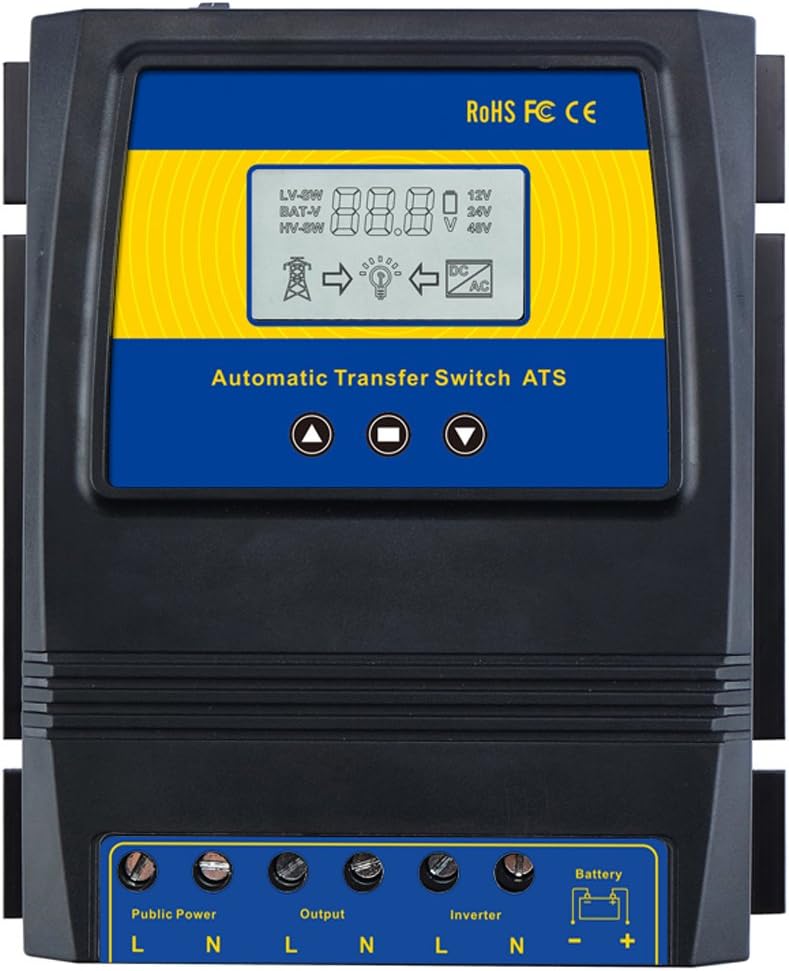
The MOES Dual Power Automatic Transfer Switch 50A is a critical smart controller for off-grid solar and wind systems, enabling automatic, ultra-fast switching between battery and grid power. Compatible with multiple DC and AC voltages, it offers customizable voltage thresholds and real-time LCD monitoring, ensuring reliable, uninterrupted power while protecting your battery and maximizing renewable energy use.


| Brand | MOES |
| Color | Black |
| Display Type | LCD |
| Item Weight | 2.9 pounds |
| Material | Gel |
| Material Type | Gel |
| UPC | 741722875483 703931915893 703931915732 |
C**R
Safe, reliable, easy config, wide rage voltage settings, good value for money
Absolutely critical component for a DIY solar installation. Easy to configure, works perfectly. Safe and reliable. If the battery power is physically disconnected it switches to grid power. All the ground leads are tied together and connected externally. Unlike other ATS brands the cut on and cut off voltage can be set from 9v to 17v for a 12v system in 0.5v increments.
S**N
If you want to make use of a small solar system you need this!
I enjoy experimenting with solar power and I've never had a permanent solar system. The main problem with using solar power as a hobby is that when your battery runs low, your inverter and all the devices connected to your inverter will turn off too. This makes it really difficult to reliably use the power you generate, at least till I learned about this little gem. With this ATS you can connect your grid power, and inverter as an input, a plug (or what ever you decide to use) as an ouput, connect a voltage monitoring cable to your battery (from the ATS), and this device will automatically switch between your inverter and grid power depending on your batteries state of charge without ANY interruption do your devices. If you are watching TV, or gaming on your computer during the switch you will not even notice it. The best part is you get to determine the low voltage at which it changes to grid, and the high voltage when it changes back to your inverter. This means that you can run your devices off your solar panel/battery and then when that power is used up it will swap back to grid power. The next day when the sun comes up and the battery charges, you are back to solar power. This is great way to make permanent use of smaller solar systems. The other exciting thing is that you could (if your batteries can support it) add more and more panels to the system and get usable solar power when the sun is up without having to spend a ton of money on batteries. There is feature i wish this device had, mainly the ability to manually choose if you want to use grid or solar power, but it's not a deal breaker. This device can show an incorrect voltage reading (might be off by .2 volts, but if you hold the up and down arrows for 3 seconds you will be able to adjust the offset. I have used this system for over a week now and it's working flawlessly, i wish i had known about it a long time ago!
J**N
Easy setup and it just works!
From what I can garner, the unit draws 7-8 watts of idle power consumption. The transfer switch worked seamlessly upon initial testing. When I forgot to turn the PV input back on, the unit had already switched to shore power by morning. Since my batteries were run nearly all the way down, with little sun the last few days the Moes unit has worked flawlessly switching back and forth from grid power to battery. Very good and easy setup after tons of research into a solar battery transfer switch. Easy to use, settings are a breeze and it just works!
R**N
Works as advertised - perfect for my application
On my unit the battery voltage as displayed is not exact. I'm using this with a Yeti 1400 and boulder 200 solar panels. In order to get the battery voltage reading, I hacked into the Yeti MPPT module by opening the MPPT and soldering leads onto the battery output cables and exiting out the back next to the fan. I verified that this provided an accurate reading by comparing the Yeti's battery voltage shown on it's display and reading the voltage at the Yeti's MPPT input terminals with a good quality Fluke multi-meter. I test this at about 50 points from 100% charged to 10%. The Yeti's displayed battery voltage exactly matched at each test point. The ATS reads about 0.3-0.4 VDC low, so I compensated for that in the ATS high/low settings. My goal is to keep the Yeti's charge in the 25% to 75% range, which should dramatically increase the battery live (reference: battery university website). In the event the grid is down for an extended period and the solar panels are unable to keep the Yeti above 25% charge, I added two DPDT relays, wiring the ATS system to the NO poles and wired the grid to the relay coils to keep the relays open. In the event the grid is down, the ATS is bypassed and the Yeti's is allowed to drop below 25% to keep my loads up. And don't freak out if you have all the line-voltage terminations done and the unit does not power up. The battery input must be terminated, which was the final item in my project (done the following day), so I thought I had a bad ATS Relays https://www.amazon.com/Enclosed-Pre-Wired-Relay-300VAC-DPDT/dp/B008HOQZ8C/ref=sr_1_1?dchild=1&keywords=rib01p&qid=1584895851&sr=8-1 Project Box https://www.amazon.com/gp/product/B081LZYNHN/ref=ppx_yo_dt_b_asin_title_o04_s00?ie=UTF8&psc=1 Cable Glands https://www.amazon.com/gp/product/B01MDTUIIA/ref=ppx_yo_dt_b_asin_title_o07_s00?ie=UTF8&psc=1
P**L
Good concept, just a few missing features
Hi, using this device with my solar power system. Great device for automatically switching from my inverter to utility power. Installation was easy and it worked as it was advertised right away. Because it does work as advertised, I am giving it 5 stars, but I hope for a 2.0 version. There are times though, when when there is going to be more lack of sun days then your system is designed for. I wish they could provide a way of pressing one of the buttons to force it to the opposite source (solar is forced to utility, utility is forced to solar) with disregards to the settings.....a manual override. Then you could press the button to force it back to automatic mode. I sometimes want to keep a little juice in the batteries if I know we will have several stormy days in a row, in case I do need it. Last, as previously pointed out, if your inverter shuts down for some reason, maybe a failure or blown fuse in the inverter, this device will not automatically switch over to utility power. As pointed out, you can manually add a relay, powered by the inverter AC output, to disconnect the battery from the battery input on this device. Having it built in, with an option in the settings, would make it bullet proof.
M**N
Works but not really a "reverse" UPS, and no relay validation
(update at bottom... had to drop it to one star, no relay validation means the two sources can be cross-linked). The unit works decently well, but I can't give it 5 stars because it isn't really a "reverse" UPS or anything of the sort. It only monitors the battery input voltage to determine when to switch. It does not monitor either of the line inputs at all. This means that if the battery voltage is fine, but the inverter gives up the ghost, this ATS will not switch from inverter to mains. And similarly, if voltage or frequency of the "inverter" input goes out of spec, this unit does not monitor that and will not switch to the mains. It goes strictly by battery voltage. It would be a whole lot more robust if the unit also monitored the "inverter" input. If battery power is lost entirely, the unit powers down, but if the unit had already switched to the mains it will remain on the mains while powered down. However, the unit does not remember its last state when it powers up again so when power comes back the unit will not wait for the battery voltage to reach the recovery voltage. Instead it will switch back to the inverter if the battery voltage is above the low-voltage point, even if it is still lower than the recovery point. I'm not going to dock a star for this behavior but it is worth noting. -- There are a few other quirks. The battery monitoring inputs are high-gauge (small wire) screw terminals, and to be totally safe you not only have to tap-off your battery to go to these inputs, you also need to put a little 2A fuse in-line so those high-gauge wires don't become a line of fire if they happen to short. And, as described in the manual, the unit is powered by the battery input. This is also a bit of a problem if the battery goes completely dead, so you have to make sure that that does not happen. I won't dock it a star on that account, but it would be a whole lot nicer if the unit could power itself from any of the inputs. There are no screw terminals for GND, you have to tie your GNDs together externally. -- I took it apart to check whether there was a relay state validation feedback circuit, which is absolutely required for any sort of automatic transfer switch. There appears to be none. It is articulating the relays in the blind which means that when the unit eventually fails it will likely cause the two power inputs to be cross-linked to each other... which is extremely dangerous. Pictures included. This make the unit a complete non-starter, a failure could cause a fire. Dropped to 1 star
Z**T
No because it's use, isn’t
This so lovely, and it works perfectly .
P**E
Quality
Do have it since 2019 , works great. I do not use grid power. I have 2 inverters and 2 solar arrays set up. Never failed. 50A is enough for my needs, for some people may not be enough .
B**S
Works great
I got this to allo me to allow devices to work all the time on my small 100W solar panel. It automatically switches the 110V power between the converter and the grid based on the power available in the battery. Works great!
R**A
MOES Dual Power Controler 50A
Packaging is good, when I unbox everything, it's fine, when I open the module, the relay is 12 volt DC 60 ampere, the specification is 50A load, in my opinion, the capacity of the relay can handle safely at 50 ampere, the jumper wire it looks high capacity conductor, at this moment, not yet testing for a real load.
A**E
Good, but no priority set possibility
No priority setting possible Useless if you want priority on external (grid) power Returned to supplier
Ş**K
Ürünü test ettim. Kaliteli
Şebeke elektriği ve akü arasında çok hızlı geçiş yapıyor. Elektrik kesintisini hissetmiyorsun. Tavsiye ederim. Tşk Amazon
E**O
Ottimo acquisto
Questo articolo era proprio quello che mi serviva per completare il mio piccolo impianto fotovoltaico. Funziona davvero bene ,semplicissimo da impostare e da gollegare . Le istruzione sono davvero ben dettagliate Finalmente non si hanno più stacchi di corrente ,perchè non appena la batteria si ricarica il dual power ritorna automaticamente al fotovoltaico.Basta accendere l'inverter la mattina e spegnerlo la sera così non devi più preoccuaprti se la batteria va sotto tensione. Io ho prefertio impostare la tensione di scarica a 12 volt e la massima a 12.5 in questo modo la batteria agm durerà molto più tempo,senza scaricarla oltre il 50%. Consiglio vivamente l'acquisto di questo prodoto. Spedizione prime ovviamente puntale e veloce
Trustpilot
1 month ago
4 days ago