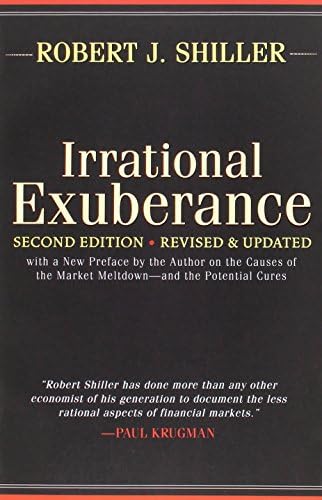


Irrational Exuberance
Product ID: 7031964
Buy anything from 5,000+ international stores. One checkout price. No surprise fees. Join 2M+ shoppers on Desertcart.
Desertcart purchases this item on your behalf and handles shipping, customs, and support to India.
Irrational Exuberance
M**D
The sociological and psychological implications of booms and busts
I usually do not fly through books on business, finance, or economics. Even as someone who is studying economics, I usually painfully press through business and economics books, but Irrational Exuberance was different. From the beginning I was hooked on all the statistics, graphs, and historical examples Robert Shiller crammed into this book. The journey you are brought on through this book is very rare for such an speculative, yet important topic.Irrational Exuberance is broken up into five parts: structural factors, cultural factors, psychological factors, attempts to rationalize exuberance, and a call to action. With 12 chapters in all, this is only a 230-page book (excluding the notes, references, and index), so can be read fairly quickly.At times this book can be very repetitive but I do believe that serves a purpose. Shiller is trying to the best of his ability to make you believe that the market is truly unpredictable and you do not have to have a MBA or a Ph.D in finance to succeed.The third chapter of this book was definitely my favorite as it summed 12 of the precipitating factors that lead to the values of the stock market to increase so rapidly from 1982 until 2000. Some factors he goes into great detail with are the capitalist explosion, new information technology, the baby boom and bust, and an expansion in media reporting business news. All of these factors were so fascinating.My favorite part from this books is when Shiller explains how many were attributing the peak of the market with the internet's birth instead of the actual reason that there was a 36% increase in S&P Composite real earnings followed by real earnings growth. "These events coincided roughly with the Internet's birth but in fact had little to do with the Internet. Instead the earnings growth was attributed by analysis to a continuation of slow recovery from 1990-91 recession, coupled by a weak dollar and strong foreign demand for U.S. Capital and technological exports, as well as cost-cutting initiatives by U.S. Companies."The main topic of this book is the phenomenon of bubbles. Along that line also discussed was negative bubbles or crashes. I was shocked to see just how many bubbles there have been in the last century. There is a great chapter on new era thinking which guides you though the 20th century and into the 21st century, discussing the major bubbles that have occurred. Shiller uses data from countries around the world to see big 1 and 5 year increases or decreases in the sock market. Shiller uses other research to explain the tendency for the markets to do this. One think I really liked about Shiller's writing was that he usually backed up everything he said with credible data and research.As an economics major, the psychological studies being incorporated with market influence was very interesting. Shiller has strong assumptions over rationality. In our classes, we are always taught that people are rational, but this book leads you to believe that they are more predictably irrational. This is highly discussed in Behavioral Economics, so it will be interesting to see how economists began to perceive the notion that people act irrationally.Shiller remains unbiased throughout the book, which helps portray the accuracy of what he is writing about. He goes through different administrations to show how they have an affect on market expectations. For example, in Reagan's term there was also a republican house majority so many people believed the current administration to be pro-business.This book is written so that anyone can pick it up, but I do recommend that you at least know a little financial vocabulary and theory. By checking Wikipedia or Investopedia whenever something unknown comes up can also be very helpful.I believe that this is a great read for those interested in investing. It is very important to understand the historic trends of the stock market in order to be a smart investor. I would recommend this book to any of my friends and family members who have invested in the markets, or plan on doing so. This is a book to understand the behavior of finance, not exactly how to make money on the stock market. One may ague that you need the basic understanding of the markets to experience success, but Shiller might argue against that.
G**T
Update -- Third Edition is Now Out (Jan 2015)
It'd nearly a decade since this book, the 2nd edition of Irrational Exuberance, made its debut in 2005. A lot has happened since then in financial markets. In this latest, Third edition, Professor Shiller updates the text to reflect developments since the 2005 second edition. This first edition of this book, in 2000, was a broad study, drawing on a wide range of published research and historical evidence, of the enormous stock market boom that started around 1982 and picked up incredible speed after 1995. The book argued that the boom represented a speculative bubble, not grounded in sensible economic fundamentals. The second edition, in 2005, added an analysis of the real estate bubble as similar to the stock market bubble that preceded it, and warned that "Significant further rises in these markets could lead, eventually, to even more significant declines." Alas, both predictions turned out to be true, as we now all know. In this latest edition, Professor Shiller updates his argument, and augments his arguments, and adds an important new chapter on the bond market, which many feel is also in bubble territory. While much of the 3rd edition repeats the basic arguments of eralier editions, there is enough new material to justify upgrading to the latest edition, even if you have the earlier ones.
A**O
Credible Exposition
The author first mentioned the twelve precipitating factorsfor a bubble. Precipitating factors like capitalism explosionand ownership society, new information technology, supportivegovernmental monetary policies and analysts' optimistic forcast.This ultimately resulted in a feedback loop which amplifiedthe 'story' behind the stock or even in a painting like MonaLisa. If a stock or any investment had a strong credible storybehind it, the story greatly enhanced the value of the investment.How was this possible? It was through the channels of the mediaand word-of-mouth. Word-of-mouth was cited to be more potentthough less accurate. The analogy of how ants communicate andhow epidermics spread was used to desbribe how bubbles formed."New-era thinking' was another reason bubbles formed. The adventof automobiles and radio in the '20s; the television in the '50s;and the internet in the '90s.The book is well structured and support material is sufficientto prove its point. One gripe is the complex and cumbersomesentence syntax used. Commas were missing where they could beinserted to make reading easier.
F**E
A Modern Classic of serious economics
Shiller takes a little know phrase uttered by Alan Greenspan, "irrational exuberance" and turns it into a best seller as no one else can.He relates how people think they know more than they do and this in turn affects their investing behaviour. He calls this "magical thinking" - thoughts that they do not have to explain or justify to others.Another aspect of overconfidence, as he points out, is that people tend to make judgements by looking for familar patterns and making an assumption that future patterns will resemble past patterns. This form of overconfidence, by many, is called "technical analysis." In my early years of investing, I spent my share of money on these "charting" systems, but now understand them for what they are - "irrational exuberence" and a waste of good money, that could be better invested elsewhere.Good book and a must read for the serious investor.
J**R
Not bad!
El libro explica la "psicología" de aquellas partes que intervienen en los mercados y como son influenciadas por factores externos que hace que se actúe de manera poco racional. Echo en falta una crítica más profunda a las políticas monetarias, y bancos centrales que hacen del mercado mas irracional.
B**M
in due time, highly useful
This is book is really interesting as it puts things in a long term perspective and gives inputs from a wide range of studies, then stop concentrating on the financial crisis and how bad banks are, now you have a new tool to analyse the exceptional situation in which we were before the crisis started in 2007. there are an amazing lot of interesting figures, facts, studies... this is a must read for all person involved in the economic analysis or financial manager. this book reads rather easily and is truely helpful.
P**É
AN EXCELLENT BOOK
As a matter of fact, I knew what I asked for, so it was no surprise. Shiller is a Nobel and a brilliant writer too.Mailing was fast, but the transporter (MRW) didn't came home. They called me and I hat to pick the book up at their premises.
R**R
Excellent book
Very useful for a intra-day trader like me. A "Must read" for all Stock Market traders and investors. First go through the "Psychological Factors" you will start to improve.
P**H
Five Stars
good
Trustpilot
2 months ago
4 days ago