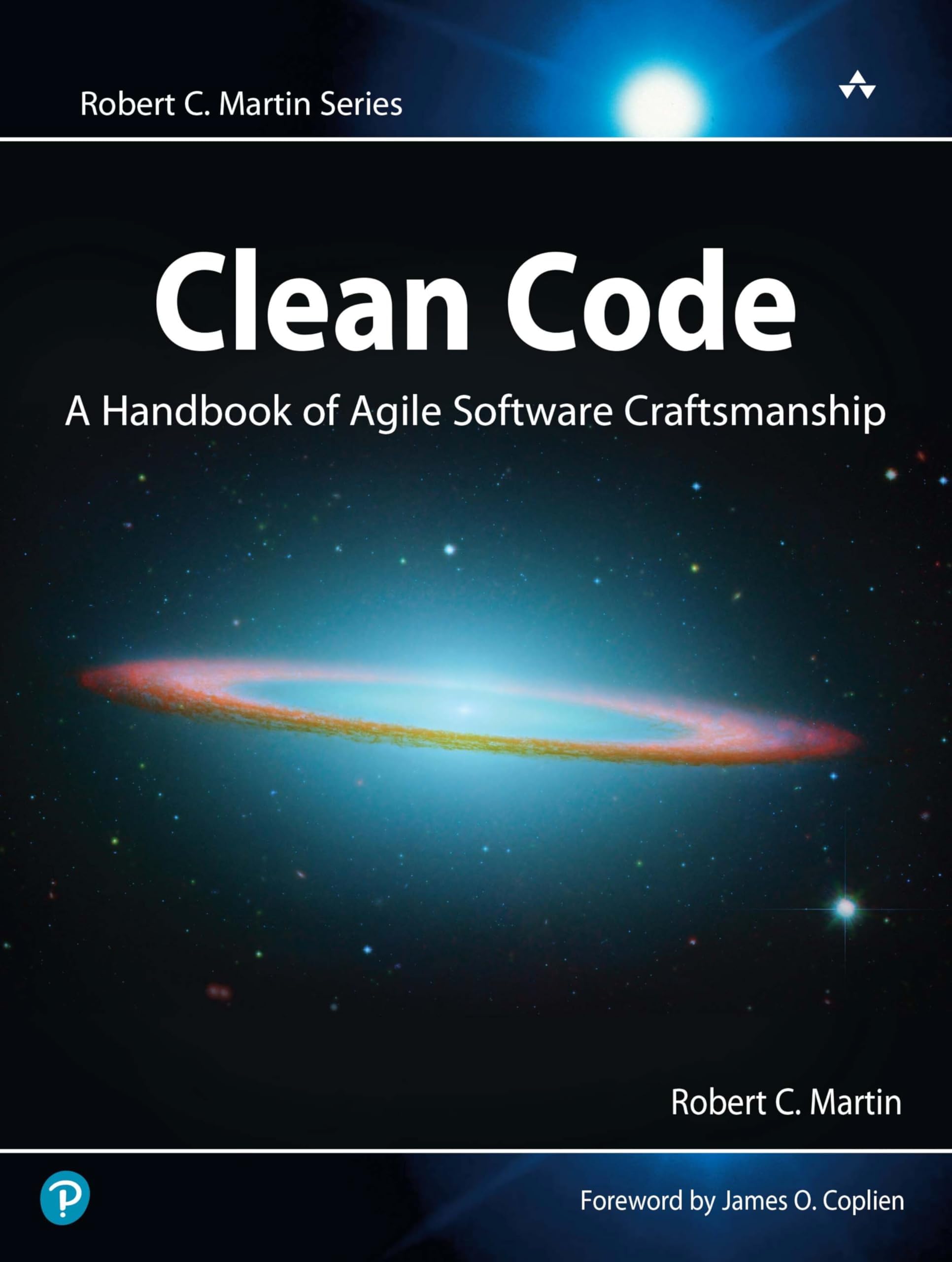
Clean Code : Import Edition :Multi colour book: A Handbook of Agile Software Craftsmanship (Robert C. Martin Series)
Product ID: 76555683
Buy anything from 5,000+ international stores. One checkout price. No surprise fees. Join 2M+ shoppers on Desertcart.
Desertcart purchases this item on your behalf and handles shipping, customs, and support to India.
Even bad code can function. But if code isn’t clean, it can bring a development organization to its knees. Every year, countless hours and significant resources are lost because of poorly written code. But it doesn’t have to be that way. Noted software expert Robert C. Martin presents a revolutionary paradigm with Clean Code: A Handbook of Agile Software Craftsmanship. Martin has teamed up with his colleagues from Object Mentor to distill their best agile practice of cleaning code “on the fly” into a book that will instill within you the values of a software craftsman and make you a better programmer―but only if you work at it. What kind of work will you be doing? You’ll be reading code―lots of code. And you will be challenged to think about what’s right about that code, and what’s wrong with it. More importantly, you will be challenged to reassess your professional values and your commitment to your craft. Clean Code is divided into three parts. The first describes the principles, patterns, and practices of writing clean code. The second part consists of several case studies of increasing complexity. Each case study is an exercise in cleaning up code―of transforming a code base that has some problems into one that is sound and efficient. The third part is the payoff: a single chapter containing a list of heuristics and “smells” gathered while creating the case studies. The result is a knowledge base that describes the way we think when we write, read, and clean code. Readers will come away from this book understanding How to tell the difference between good and bad code How to write good code and how to transform bad code into good code How to create good names, good functions, good objects, and good classes How to format code for maximum readability How to implement complete error handling without obscuring code logic How to unit test and practice test-driven development This book is a must for any developer, software engineer, project manager, team lead, or systems analyst with an interest in producing better code. Review: Absolute worth it ! - This book is a must read for all the engineers who want to read more clean and understandable code. Book is beginner friendly, I loved it. Review: Realize what "Clean Code" feels like..! - I have loved writing code for a very long time. Overtime, I have realized that writing awesome code needs much more discipline than skill. This book emphasizes this very fact in a unique way. The author "uncle Bob" does make very strong & clear remarks with very good supporting examples & rationale. This book can thoroughly embarrass good / great code that lacks discipline & hence foresight. I recommend reading this book more than once for those... who would like to write code... who would like to read code... who would like to review code... who would like to maintain code... who would like to design software... who would like to be part of a software development team for over 2 years... Irrespective of your experience in writing / reading / designing code you think is great (or good enough) you must read this book to know what "clean code" feels like..! and then look past your ego and go back to correct your code :)


| Best Sellers Rank | #15,975 in Books ( See Top 100 in Books ) #12 in Software Design & Engineering #830 in Reference (Books) |
| Customer Reviews | 4.5 out of 5 stars 6,588 Reviews |
R**A
Absolute worth it !
This book is a must read for all the engineers who want to read more clean and understandable code. Book is beginner friendly, I loved it.
G**I
Realize what "Clean Code" feels like..!
I have loved writing code for a very long time. Overtime, I have realized that writing awesome code needs much more discipline than skill. This book emphasizes this very fact in a unique way. The author "uncle Bob" does make very strong & clear remarks with very good supporting examples & rationale. This book can thoroughly embarrass good / great code that lacks discipline & hence foresight. I recommend reading this book more than once for those... who would like to write code... who would like to read code... who would like to review code... who would like to maintain code... who would like to design software... who would like to be part of a software development team for over 2 years... Irrespective of your experience in writing / reading / designing code you think is great (or good enough) you must read this book to know what "clean code" feels like..! and then look past your ego and go back to correct your code :)
P**A
Good content with worst paper quality
This is a good book to get knowledge about clean coding but paper quality is very bad
R**L
If you think you don't need this, you are probably wrong.
Well, if you are still thinking whether or Not to purchase this one, please stop thinking. Just get it already. Its WORTH every penny. When going through this master piece, you connect with a developer deep down in your subconscious who was subdued in writing crappy code by Deadlines and Circumstances. If you are the person to stand up and do the RIGHT thing, this gem would guide you to WHAT the RIGHT THING is!And guess what, even that's worth it. If you want someone to write Maintainable, Readable Code; ask them to go through this once. Not specific to Java developers. I am a .Net Developer. Would recommend this over Refactoring by Mr.Fowler(even that's a great read though)
N**A
Crux of book: invest time on code readability (for maintainable projects)
This book didn't teach something out of the box but it stressed on keeping code readable, one should always see the projects from the eye of readability such that eventually they are easy to collaborate on, if one keeps this perspective all rules / suggestions in this book will come to you.
P**R
Book is in good condition
The book was delivered in good condition. After looking at the reviews I am in doubt if the book is original or not. But I will give it the benefit of the doubt and anyways It doesn't matter even if it is fake but has all the content of the original book.
R**I
Good book on how to write clean code
The book helps you identify how bad code looks like and suggests how it should have been written in the first place. Lot of code snippets have been shown to consolidate our understanding about a particular topic in consideration. Of course, it will be difficult to remember all the concepts by just one time reading. As such, this book will have to be read and referred multiple times by the reader to have the concepts etched in the mind.
S**A
Must buy for the developers who want to write good maintainable code.
This book is very impressive in making one understand how to write clean code. Though I am currently studying third chapter I am finding it applicable in the production code base. This is certainly a very good buy if you want to learn good code that not only makes the compiler happy but will make the day for the maintainer as well. Amazon service was very good in delivering the product in perfect shape.
A**.
Hat mir persönlich sehr gut gefallen
Ein Muss für jeden, der besser programmieren will – nicht nur für Anfänger „Clean Code“ hat mir persönlich sehr gut gefallen und ich würde es jedem empfehlen, der sich ernsthaft mit Softwareentwicklung beschäftigt – egal ob Anfänger oder erfahrener Entwickler. Als Ergänzung beim Programmieren lernen: Gerade wenn man neu ins Programmieren einsteigt, ist das Buch eine perfekte Ergänzung, weil es nicht nur zeigt, was man programmieren soll, sondern wie man es sauber und verständlich macht. Es geht weit über Syntax und Sprache hinaus und behandelt die Prinzipien guten Codes – etwas, das in vielen Kursen oft zu kurz kommt. Auch für Fortgeschrittene absolut lesenswert: Auch wenn man schon programmieren kann, lohnt sich die Lektüre. Das Buch hilft, schlechte Angewohnheiten zu erkennen und zu reflektieren, die sich im Laufe der Zeit eingeschlichen haben. Es geht dabei nicht um theoretische Regeln, sondern um praktische, nachvollziehbare Beispiele und konkrete Tipps, die man direkt umsetzen kann. Fazit: „Clean Code“ sollte jeder Programmierer kennen und gelesen haben. Es hat mir geholfen, meinen Code strukturierter, lesbarer und verständlicher zu schreiben – was nicht nur mir, sondern auch meinen Kollegen zugutekommt. Absolute Empfehlung für alle, die sauberen, wartbaren Code schreiben wollen – ein echter Klassiker der Softwareentwicklung.
C**A
Excelente libro
Excelente libro
S**M
Does what it says on the tin
Every so often, a book comes along that codifies best practice in a way that manages to illuminate the path from where things are right now, to a better place that we'd rather be -- things like Fowler et al. Refactoring: Improving the Design of Existing Code (Object Technology Series) or the Gang of Four Design patterns : elements of reusable object-oriented software . This is one of those books. And if much of the material is the sort that seems obvious in hindsight -- well, that is the mark of a well written book, to make the concepts that clear. Taking a series of real world examples -- open source projects with significant user bases, including FitNesse and JUnit -- a series of worked examples take us from good, or at least adequate, code, to a form which is better factored, and easier to read, with the steps along the way clearly marked. Yes, even some of Kent Beck's code is put under the microscope, and carefully polished that extra stage or two more. The reader is cautioned that, without working long hours to follow these examples, this will be just another of those feel-good books. I don't quite agree -- spending just a little time to follow the transformations, and then reflecting on one's own outpourings should be enough to make this a feel-bad book. All the sins from obscurely named variables to sprawling functions that gaily mix abstraction levels, we've all done them (especially programming in FORTRAN on minicomputers with slow stacks and a rule of thumb that 1 call ~ 40 loc in terms of performance). The maxim to take from the book is based on Baden-Powell's "Try and leave this world a little better than you found it", and owes to the same school of thought as "whenever you are in the garden, pull at least one weed". The meat of the book is in distinguishing what are the weeds from the intended crop. So read it, understand the examples, and then refer to it often -- like the other titles mentioned, it is a reference work, and should join them as among the most thumbed on your bookshelf.
U**G
must read
.
G**E
This book is worth it for any programming language.
This is a great book. I have found the concepts informative and helpful. I'm glad I decided to get it. As an aid, I listened to the audio book version while I followed along reading it. This made taking notes a dream. I am now on my way to leveling up my programming skills.
Trustpilot
5 days ago
3 weeks ago